John and Mary had already walked that piece of Northern California ground. They had lived on the rural property for years, taken the trail, passed the same trees, learned the usual shapes of rocks and brush. Then, during a walk with their dog in February 2013, one of them looked down and saw the rim of a rusted can pushing out of the dirt.[1]
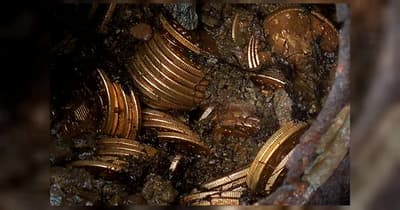
By the time the digging stopped, the can had become the first piece of the Saddle Ridge Hoard, the largest known buried gold coin discovery recovered in the United States.[2] The couple found eight cans in all. Inside were 1,427 U.S. gold coins minted from 1847 to 1894. Their face value was $27,980. Their collector value was estimated at more than $10 million.[3]
For about two weeks, the path became a place to revisit with a metal detector.[1] More cans came out of the ground. David McCarthy of Kagin's helped evaluate the find, and the inventory kept turning ordinary denominations into collector shock: mostly twenty-dollar Liberty Head double eagles, many struck at the San Francisco Mint. Professional Coin Grading Service later authenticated the hoard before part of it went on public display.[3]
An old tree had been offering a clue before anyone opened the ground. The couple had noticed an empty rusty can hanging from it, partly swallowed by the trunk as the tree grew around it. They had wondered if it marked a grave. Later, they described the buried cans as set near an oddly shaped stone that pointed toward Polaris.[4] The place had not hidden the fortune perfectly. It had made the clue look worthless.
When the discovery became public in 2014, the couple still would not give the public what it wanted most. Kagin said they were middle-aged, married, and living on the rural property, but their names and the location stayed private.[5] The reason was not romance. It was trespass. A patch of ground that had once been safe enough for dog walks could turn, overnight, into a map for strangers with shovels.
The coins made the couple rich, but they also made their ordinary land harder to describe. They could say there was a hill they called Saddle Ridge. They could say a can came out of the dirt. They could not say where. On one side of the find was an unknown person who buried eight cans and disappeared from the record. On the other side was a living couple trying not to turn their home into a destination.
In the surviving photographs, the coins are bright, but the can looks like trash.[6] That is the useful part to keep. Someone once carried eight cans of gold into the California dirt and left them there. Years later, the first visible clue was not a gleam or a lockbox or a pirate-chest promise. It was a scrap of metal on a path familiar enough to miss.