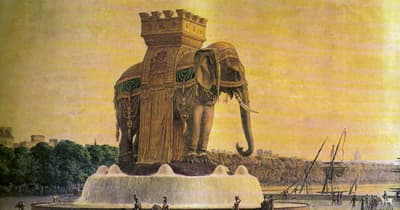
Levasseur's commute ended inside the foot of an elephant. In the early 1830s, the guard assigned to Napoleon's abandoned fountain model at the Place de la Bastille was still keeping watch from within the monument itself, climbing into a plaster animal that Paris had never quite decided how to finish or how to remove.[1] The address was ridiculous only until you stood under it. The elephant rose about 24 meters, with a staircase in one leg and enough hollow space to shelter a man, collect rain, and give rats a place to multiply.[1][2]
Napoleon planned a bronze elephant fountain for the Place de la Bastille, cast from captured cannon. Paris built only the full size plaster model, and for decades the crumbling monument was guarded by a man who reportedly lived inside one of its legs.
The order called for bronze taken from Spanish cannon, water pouring from the trunk, and a staircase tucked inside one of the legs.[1] The Bastille prison had been dismantled after the Revolution. On that same ground, Napoleon wanted a colossal creature that would turn a site of royal imprisonment into an announcement of imperial power.
Work reached the temporary stage in 1813 and 1814, just as Napoleon's rule was coming apart.[2] Paris received the rehearsal prop and never got the permanent cast. The plaster elephant stayed where the bronze one was meant to stand, patched and watched while governments changed around it. Rain marked it. Holes opened. The great animal became part construction model, part ruin, part neighborhood nuisance.
Children played near the animal while visitors came to stare and officials argued over whether it should be repaired or demolished.[1] Levasseur kept his post in the elephant's foot through that long delay. A monument designed from cannon metal had been reduced to a caretaker's shelter, with the grand staircase and hollow belly serving the daily needs of one man guarding a failed promise.
In Les Misérables, Gavroche slips into the elephant through a hole under its belly, and Hugo pauses over the odd mercy of the place. The old beast keeps out cold, rain, mud, snow, and doors slammed against a child.[3] The boy belonged to fiction, but the shelter did not. Paris had left a giant plaster animal in the square long enough for a novelist to make its neglect feel useful.
Workers finally broke the elephant apart in 1846.[2] Later retellings linger on the rats said to have rushed from the broken structure and unsettled the neighborhood for weeks.[1][4] Whether that last swarm grew larger in memory or not, it fit the object Paris had kept. Napoleon asked for bronze, cannon, water, and height. The city ended up with plaster dust, a guard's cramped room, children peering at holes, and an elephant that survived longest as a place someone could crawl inside.
Sources
- https://www.discoverfrance.net/France/Paris/Monuments-Paris/Bastille5.shtml
- https://en.wikipedia.org/wiki/Elephant_of_the_Bastille
- https://www.gutenberg.org/files/135/135-h/135-h.htm
- https://web.archive.org/web/20120330235710/http://cultureandstuff.com/2011/05/24/lost-paris-the-elephant-on-the-place-de-la-bastille/