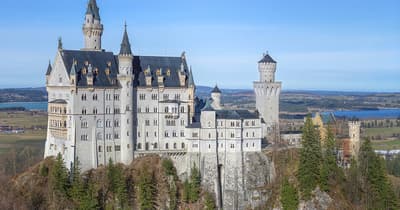
King Ludwig II wanted a castle that looked ready for a knight. Then he put telephones on the upper floors.
On the third and fourth floors of Neuschwanstein, the medieval dream had a very modern ring. The Bavarian Palace Administration lists telephones there, along with hot air central heating, running water on every floor, hot and cold water in the kitchen, automatic flushing toilets, an electric servant-bell system, and a meal lift that could send dinner upward without a servant carrying plates through the stairways.[1]
Work on the mountain site began in 1868, and the Palas rose from 1872, but the old-looking castle was never built by old methods. The Throne Hall needed modern engineering, including an encased steel structure.[2] Steam driven cranes helped assemble walls meant to evoke chivalry. Large industrial windows sat inside the historicist costume.
In the rooms Ludwig planned for himself, the past arrived with the worst parts quietly removed. Neuschwanstein had Romanesque arches, painted legends, towers, swans, and even a grotto, but it also had plumbing, heat, bells, and service systems. The official history of the palace describes nineteenth century historicism as a way of perfecting old styles with modern craft and technical means.[3] Ludwig did not have to choose between fantasy and convenience. He built a fantasy that could be heated.
By the time these rooms were being fitted, Ludwig had already retreated from the ordinary work of kingship. He became king in 1864, then watched Bavaria lose power after defeat by Prussia. The palace administration describes him spending more time in the mountains and keeping his private theater running with performances staged for him alone.[3] Neuschwanstein suited that life: part refuge, part opera set, part carefully controlled kingdom.
Seven weeks after Ludwig died in 1886, the private refuge opened to visitors.[4] A house designed for withdrawal became one of the most looked-at castles in Europe. People came for the towers and legends, but the stranger artifact was inside the walls: a nineteenth century machine for feeling medieval without being cold, dirty, or inconvenienced.
A visitor can still read the bargain in the building. People rarely want the past back whole. They want its glow with the discomfort stripped out. Neuschwanstein keeps that wish in stone: a castle shaped like a legend, where a king could press a bell, flush a toilet, and wait for dinner to rise through the floor.