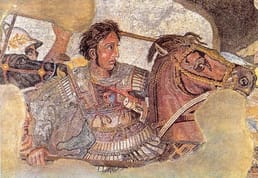

Alexander had armies, doctors, engineers, messengers, cavalry, siege crews, and the kind of confidence that makes maps look temporary. Plutarch preserves a smaller habit from the campaign trail: when Alexander slept, he kept Homer's Iliad under his pillow beside a dagger.[1]
Alexander the Great reportedly slept with a copy of the Iliad, corrected by Aristotle, beside his dagger. To him, the poem was field gear, close enough to reach in the dark.
Plutarch says the book was Aristotle's corrected copy, later known as the casket copy, and that Alexander called it a portable treasure of military virtue and knowledge.[1] The pairing is what catches. A dagger answers a body in danger. A poem answers the imagination. Alexander put both within arm's reach.
Philip of Macedon hired Aristotle when Alexander was a teenager, and the lessons left the prince with a lifelong love of reading, according to World History Encyclopedia's summary of the tradition.[2] The teacher gave him more than polish. He gave him a way to treat books as instruments. For a young king raised on horses, hunting, and succession danger, Homer was not decoration for a shelf. It was a manual for wanting glory without admitting how much glory could cost.
In upper Asia, Plutarch adds, Alexander found himself short of books and ordered Harpalus to send more.[1] The list was not a ruler's trophy case. It included histories, tragedies by Euripides, Sophocles, and Aeschylus, and lyric poems. Even during conquest, he provisioned the mind as carefully as a camp quartermaster stocked grain.
The route later ran through Asia Minor, Egypt, Persia, Sogdia, the Punjab, the Indus valley, and Babylon, the kind of sequence that can make Alexander sound like weather moving across a map.[3] The pillow habit slows him down. Before the next march, before the next argument with officers, before another city decided whether to resist him, there was a man arranging two things by his head.
World History Encyclopedia notes that Alexander linked himself to Achilles and Heracles and modeled his behavior after them.[2] Achilles is a dangerous hero to choose. The Iliad is full of honor, rage, grief, bargaining, sulking, killing, and men realizing too late what their stories have cost. Alexander seems to have read it as instruction anyway. A conqueror loving a war poem is predictable. Carrying a poem about the price of heroic anger as if it could help govern his own is stranger.
The casket copy can sound almost too neat now, a legend made for museum glass. But the image keeps its pressure: a closed book, a blade, a sleeping king, and a campaign waiting outside the tent. Alexander did not leave Homer far away in a library. He put the poem where a worried soldier would put a weapon, close enough to touch before morning.