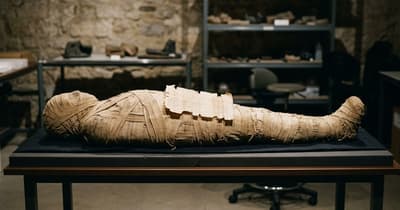
Leah Mascia was not looking for a schoolbook when she examined the mummy from Oxyrhynchus. The Roman era body had come out of a damaged limestone tomb in Al Bahnasa, south of Cairo, with wrappings, funerary objects, and the usual burden of unanswered questions. Then the papyrologist noticed a scrap placed inside the mummy's wrappings near the abdomen. It was Greek. It was literary. It was Homer.
A 1600 year old Egyptian mummy was found with a papyrus passage from Homer's Iliad tucked into its wrappings, apparently as part of the embalming process. Researchers say it is the first known Greek literary text deliberately used this way in a mummy.
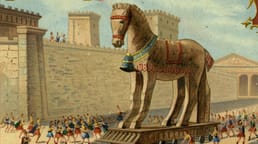
The fragment came from Book II of the Iliad, the long catalog where Homer names the Greek ships that sailed to Troy.[1] A mourner or embalmer had placed an epic roll call against a dead person's body. Other papyri found in mummification contexts could carry magical or ritual formulas, the kind of text meant to protect a person on the passage out of life.[2] This scrap carried warriors and ships.
At Oxyrhynchus, papyri had been turning up for more than a century before this tomb was opened. Excavators have pulled literary texts, government records, leases, horoscopes, wills, and private letters from the old city and its dumps.[3] In Greco Roman Egypt, Homer was not an exotic import sitting in one scholar's hand. Copies circulated, students read him, and private citizens could own him.[3]
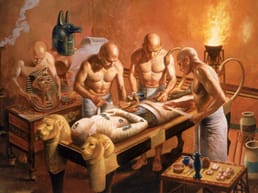
Inside Tomb 65, the old reading habit had moved into a funeral job. The mummy was one of several in a complex of three limestone chambers, some decorated with gold leaf or geometric patterns.[3] CNN reported that three mummies had gold foil on their tongues and another had copper, details from Egypt's Ministry of Tourism and Antiquities.[1] The family behind this burial probably had enough money to pay for embalming, but researchers still do not know whose body it was or why this text was chosen.
Ignasi Xavier Adiego, a University of Barcelona philologist on the project, told CNN that the papyrus is too fragile for destructive study. The team has read what it can without taking it apart, and he said higher tech imaging may eventually help.[1] For now, the reason for the fragment is still open. It may have acted like a protective object. It may have been a signature or leftover piece from the embalmer. It may have meant something personal that the tomb no longer explains.
The torn papyrus is small enough to fit in the palm of a conservator's hand, which is why it lingers. Someone in Roman Egypt handled a body, packed the wrappings, and left a passage about ships where another burial might have carried a spell. The poem that usually begins in classrooms and libraries turned up in a darker, quieter archive: a mummy's abdomen, carrying a list of Greek ships into the silence.
Sources
- CNN, Egyptian mummy unearthed with literary text on abdomen in first ever find
- Scientific American, Passage from Homer's Iliad discovered in the abdomen of a Roman era Egyptian mummy
- Smithsonian Magazine, Archaeologists unearth a papyrus fragment from the Iliad tucked inside a 1600 year old Egyptian mummy
- Popular Science, Egyptian mummy discovered stuffed with excerpt from The Iliad