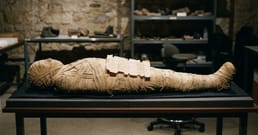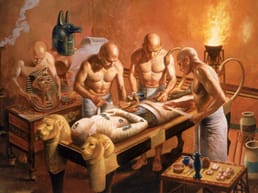
For most museum visitors, the ancient dead arrive through glass: stone jars, typed labels, a careful distance between your body and theirs. Senetnay's afterlife came closer than that. Researchers took residue from jars that had once held her organs, translated the chemistry into a perfume recipe, and planned for modern visitors in Denmark to smell a burial practice from about 1450 BCE.[1]
Scientists reconstructed the scent of Senetnay's ancient Egyptian mummy balm from residue in her canopic jars. The Scent of Eternity turned a 3500 year old burial mixture into something museum visitors could encounter with their own noses.
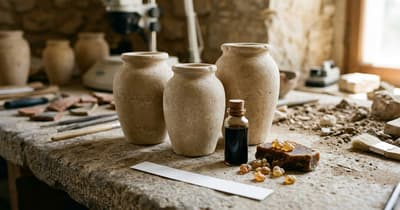
The woman behind the scent was Senetnay, a noble woman of Egypt's 18th dynasty. The Scientific Reports study traces the residue to canopic jars from Tomb KV42 in the Valley of the Kings, excavated more than a century ago by Howard Carter.[2] The jars are now in the Museum August Kestner in Hannover. One had contained her lungs. Another had contained her liver.
Barbara Huber's team scraped balm residues from empty limestone jars and ran them through gas chromatography and mass spectrometry, instruments built to separate molecules that a human nose could never sort by itself.[2] The recipe they recovered sounds less like a tomb inventory than a workbench: beeswax, plant oil, fats, bitumen, conifer resin, a balsamic substance, and dammar or Pistacia tree resin.[1]
Dammar and Pistacia point away from a sealed Egyptian tomb and toward the living routes that supplied it. The researchers argue that Senetnay's balm shows elite burial practice drawing on long distance networks in the second millennium BCE.[1] Her body was being prepared for eternity, but the mixture also carried ordinary evidence of human labor: someone sourced the resin, someone kept the recipe, someone chose costly materials for one woman's organs.
Perfumer Carole Calvez joined the project after the lab had done its work. Together, the team recreated an ambient version of the balm under the name Scent of Eternity.[1] ARTnews described the result as a reconstruction of an ancient Egyptian mummy balm's scent for public display.[3] It is an unusual museum bargain. The original jars stay protected. The visitor gets a harmless strip of air.
The nose collapses distance quickly. A photograph waits for you to study it, and a chemical chart waits for you to understand it, but scent enters the body before the brain has finished arranging the facts. For a second, Senetnay's funeral equipment leaves the display case and becomes a material choice that still has reach.
In Hannover, the limestone jars still do what old objects often do: they sit quietly while people lean in and try to imagine the life around them. What survived was a trace on stone, enough for scientists to rebuild a little cloud of beeswax, resin, oil, and ambition. A visitor holding that blank scent strip smells the care someone once spent trying to make death negotiable.
Sources
- Max Planck Institute of Geoanthropology, "The Scent of the Afterlife Unbottled in New Study of Ancient Egyptian Mummification Balms"
- Huber et al., Scientific Reports, "Biomolecular characterization of 3500-year-old ancient Egyptian mummification balms from the Valley of the Kings"
- ARTnews, "Scientists Recreate Scent of Ancient Egyptian Mummy Balm"