The British Museum put a date on the snail: March 25, 1846. It put a name on it, too, Helix desertorum. Then the shell sat gummed to a piece of cardboard, its opening facing down. Inside the shell, the animal was still alive.[1]
When Grant Allen retold the episode in 1889, he explained how a living animal could arrive in a collection of empty shells. Collectors generally expected specimens sent from abroad to have had their inhabitants removed. They preserved the hard outer shell; the flesh was supposed to have been left behind. This one had travelled from Egypt with its occupant still inside. The name and date on the card recorded its arrival without revealing the mistake.[1]
On March 7, 1850, someone noticed that the paper beneath the shell had become discoloured. Samuel Woodward's A Manual of the Mollusca records the observation: the snail appeared to have come out at some point while attached to the card. Woodward described the marks as apparently made in an attempt to get away. The animal had then withdrawn and sealed its opening with a glistening film.[2]
The marks on the paper offered a trace of movement during those nearly four years, though Woodward's account could not establish when the animal had stirred, or how often. The dates on either side of the interval are precise. What happened inside it has to be pieced together from a stained card and a sealed shell.[2]
After finding the marks, the people examining the specimen immersed it in tepid water. The snail recovered. By March 13, Woodward could report it "alive and flourishing." In Allen's later telling, it put its head out and climbed to the top of the basin. The museum now had an animal moving about in water where it had previously had a shell fixed to paper.[1][2]
In the Egyptian desert, the species now called Eremina desertorum lives with the dry conditions that make such survival useful.[3] Woodward discussed the museum specimen among examples of snails surviving long confinement, and described the torpor of land snails during hot, dry weather as a "summer sleep." That capacity had carried this animal through a journey to England and years mounted in a collection.[1][2]
On page seven of Woodward's manual, the specimen appears in a woodcut drawn from life in March 1850. Its body extends beyond the coiled shell; its head and tentacles reach forward. The cardboard is gone. Beneath the picture, a short caption records the correction: "From a living specimen in the British Museum, March, 1850."[2]
Sources
- Grant Allen, Seven-Year Sleepers (1889)
- Samuel Woodward, A Manual of the Mollusca, pp. 7 and 18-19 (1851)
- Eremina desertorum: species and historical context
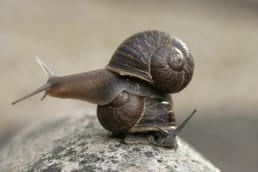
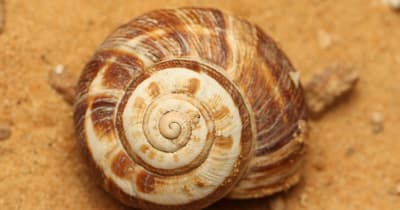
Hero image: illustrative modern photograph of an Eremina desertorum shell in Israel, not the historical museum specimen. Photo by Chaym Turak via Wikimedia Commons, cropped and resized. Image and derivative licensed CC BY-SA 4.0.