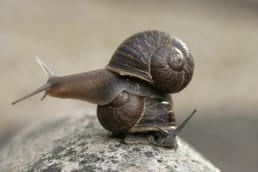
In 2016, a retired scientist found a garden snail that did not match the usual garden-snail plan. Its shell coiled left instead of right. Its reproductive organs were inverted too, which meant an ordinary right-coiled mate would be a poor fit. The snail was named Jeremy, and researchers at the University of Nottingham began asking the public for other left-coiled snails.[5]
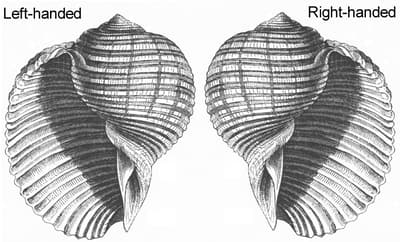
Most coiled snail shells are dextral, with the opening on the right when the shell is held tip-up and facing you. A left-opening shell from a normally right-handed species is a rare sinistral form, sometimes sought by collectors and awkward for the living snail.
Hold a spiral shell upright, with the tip pointing up and the opening facing you. If the aperture is on the right, the shell is dextral. If the aperture is on the left, it is sinistral.[3] The whole test fits in one hand. No microscope, no field guide, just the direction of a doorway in a piece of calcium carbonate.
Most familiar snail shells open to the right. FactRepublic states the old collector’s version plainly: almost all shells open on the right, except for a few snail species whose shells normally open on the left, and a left-opening shell from a normally right-handed species can be rare and highly sought after.[2] The important distinction is species by species. A left-handed shell is not automatically unusual. The Lightning Whelk, for example, is normally sinistral, so its left-opening shell is simply the standard design for that species.[3]
The oddity is a left-handed individual in a normally right-handed line. To a collector, it can look like the familiar shell has been held up to a mirror. To the snail, the reversal can be more consequential than a visual trick. Atypical left-handed snails may have their genital organs reversed, which can prevent successful mating with normal dextral partners.[3]
The trouble with being Jeremy
Jeremy became famous because rarity created a practical problem. A left-coiled garden snail could not easily breed with the ordinary right-coiled snails around it, so the Nottingham researchers put out a public appeal for other lefties.[5] Some were found and sent in. Jeremy eventually produced offspring, but they all coiled to the right.[5]
That result made the shell less like a simple family trait and more like a developmental clue. The Generalist Academy summary notes one possible explanation, called maternal effect: the direction of coiling may depend not only on the genes of the snail itself, but on genes expressed by its mother.[5] In that version, the baby snail carries one inheritance, while the direction of the shell records something decided one generation earlier.
Researchers have tested shell handedness in other snails too. At the Bailey-Matthews National Shell Museum, José H. Leal described work by Japanese researchers Masanori Abe and Reiko Usuda on the freshwater snail Lymnaea stagnalis. Using gene-editing technologies, they induced mutations in normally dextral snails and changed the coiling direction in their offspring.[3] The shell’s left-or-right turn is not just ornament. It is tied to the animal’s early body plan.
How to spot the rare one
The beachcomber’s method stays wonderfully ordinary. Put the shell in your palm. Point the spire upward. Turn the opening toward your face. Right side, dextral. Left side, sinistral.[3] Then comes the second question, the one that decides whether the shell is common or remarkable: is that species normally right-handed or left-handed?
The museum gives a clean example from its collection: a large and very rare sinistral Junonia was once shown with a large dextral Junonia of the same species.[3] The two shells had the same general form, but their openings faced opposite ways. One was the ordinary body plan. The other was the familiar shell reversed.
That is why a small left-hand opening can stop a collector in mid-sort. Most shells fall into the expected position when turned upright, aperture on the right. Once in a while, the opening appears on the left, and the shell in the hand becomes a little record of biology taking the other turn.