The first thing to understand is that no one went looking for a miracle in a shopping bag.
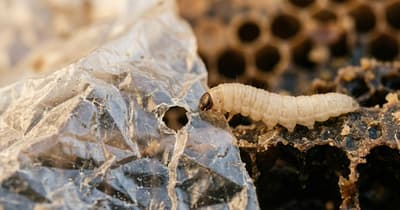
Federica Bertocchini was doing an ordinary beekeeper's chore: cleaning wax worms out of a hive. To a beekeeper, the larvae are not a marvel. They are the houseguest who eats the walls. They burrow through honeycomb, leave webbing behind, and turn the careful architecture of bees into damage. Bertocchini gathered the pale caterpillars and put them in a plastic bag. Sometime later, she noticed the bag was full of holes.[1]
This is the kind of discovery science loves because it begins almost too plainly. A grub, a bag, an accident. But the question it raised was larger than the bag. Polyethylene, the plastic used in shopping bags and packaging films, is popular for the same reason it is troublesome: it lasts. It resists water, weather, and ordinary decay. It is a material designed to outlive the errand that required it.
That is why the wax worm became famous. Researchers reported in 2017 that caterpillars of the greater wax moth could damage polyethylene, suggesting that something in the animal's biology was doing more than merely chewing holes.[1] The finding joined a broader cast of organisms that appear able to attack plastic, including bacteria, fungi, and other so-called plastivores.[2] More than 50 such species have been described or discussed, but the wax worm had the advantage of theater. It made the invisible chemistry visible.
The later work was even stranger. In 2022, researchers reported that wax worm saliva contains enzymes that can oxidize and begin depolymerizing polyethylene within hours under mild conditions.[3] That matters because polyethylene breakdown usually begins with a stubborn first step. The long molecular chains must be opened up before anything like real degradation can proceed. The worm's saliva seems to help start that process.
But this is where the story becomes less comforting, not more. A wax worm is not a municipal waste system. A lab result is not a landfill strategy. The larvae did not evolve to forgive modern packaging. They evolved in and around waxy environments, and scientists are studying whether the chemistry that serves them there can be understood, improved, or borrowed.
There are other clues in this direction. Engineered enzymes have broken down PET, the plastic common in bottles, into reusable building blocks under controlled conditions.[4] That is the hopeful version of the story: biology may help turn some plastics from permanent clutter back into chemistry. Not magic. Not disappearance. A tool.
The uncomfortable part is what we ask of that tool. We like cleanup stories because they leave the habit untouched. The bag gets holes, the bottle becomes raw material, the pile somehow shrinks while life continues as before. Yet plastic pollution was never only a chemistry problem. It was a social agreement. We decided that a thing could be useful for ten minutes and burdensome for generations, then called it disposable.
The wax worm does not rescue us from that bargain. It exposes it. Its saliva can begin to break a bond that human industry made durable on purpose, but the larger bond is ours: the one between convenience and forgetting. The real lesson in the bag is not that nature will clean up after us. It is that even nature has to work hard against permanence once we have designed it into the world.
Sources
- Current Biology: Polyethylene bio-degradation by caterpillars of the wax moth Galleria mellonella
- Grist: From fiction to reality, the potential of plastic-eating organisms
- Nature Communications: Wax worm saliva and the enzymes therein are the key to polyethylene degradation
- Nature: An engineered PET depolymerase to break down and recycle plastic bottles