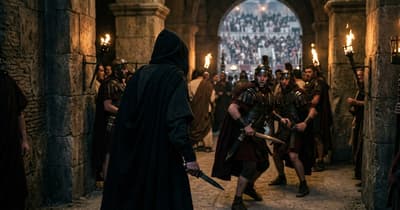
The plot against Commodus had a simple shape. A young emperor would enter the amphitheater. A man named Claudius Pompeianus Quintianus would be waiting near the passage with a dagger hidden under his robe. If he moved quickly, the guards might have only a second to understand what was happening.[1]
At the entrance, according to the ancient historian Herodian, Quintianus drew the dagger and raised it where Commodus could see it. Then he shouted that the Senate had sent him to kill the emperor. The warning gave the bodyguards exactly what an assassin is never supposed to give them: time. They seized him before he struck.[2]
In 180, Marcus Aurelius left the empire to a son who was still young and eager to return to Rome. Commodus made peace on the northern frontier and came back to the capital.[1] After the failed attack, modern summaries of the reign describe a sharper turn toward suspicion, cruelty, and arbitrary power.[3]
Lucilla, Commodus's older sister, stood behind the plot in the accounts that survive. She had once been married to Lucius Verus, had held the title Augusta, and had watched her public standing shrink under her younger brother. Senators were drawn in too. Quintianus was supposed to turn that resentment into one fast act.[4]
Under the robe, the dagger still had its best advantage because nobody had seen it. Quintianus gave that advantage away for a line of political theater. He wanted Commodus to know the blow had a sponsor. This was not only a knife, he wanted the emperor to understand. This was the Senate's knife.
After the guards seized Quintianus, the sentence he shouted stayed useful to Commodus. Herodian says the claim became an early reason for the emperor's hatred of the Senate. Other accounts connect the aftermath to executions, purges, Lucilla's exile, and eventually her death.[2][4]
The unused dagger had already traveled through the most dangerous part of the plan. It passed under the robe, through the crowd, and into the narrow entrance where Commodus was close enough to threaten. Then Quintianus spent the safest second he had explaining what the dagger meant.
In the end, the speech may have mattered more than the blade. It did not kill Commodus. It did help turn a private ambush into public evidence for an emperor already learning to see enemies around him. The picture that lasts is almost absurd: a knife in the air, an announcement in the doorway, and the guards moving first.