An Athenian galley left the harbor with a death sentence on board. Across the Aegean, at Mytilene on Lesbos, the general Paches and his army were waiting for instructions from home. The order was blunt: kill the adult men, enslave the women and children, and make an example of a city that had rebelled.[3]
In 427 BC, Athens reversed its order to massacre Mytilene after a second vote in the Assembly. A second ship was sent after the first, and according to Thucydides, it reached Mytilene just in time to stop the original decree from being carried out.
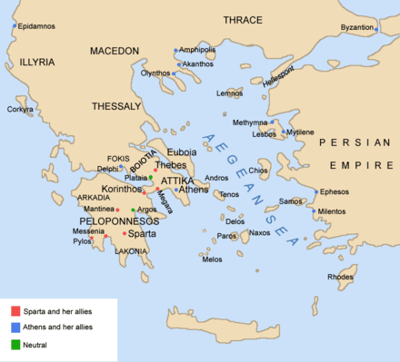
Mytilene occupied an awkward place in the Athenian empire. It was one of the last members of the Delian League that still supplied its own warships instead of paying tribute, and it was ruled by an oligarchy rather than a democracy.[1] To Athens, that made the city valuable, independent, and suspect all at once.
When the Peloponnesian War set Athens and Sparta against each other, Mytilene tried to break loose from Athenian control and sought Spartan help.[1] The revolt failed from the inside as much as from the outside. Thucydides says the city’s food was running short while the expected Peloponnesian fleet delayed, and the common people, newly armed for a sortie, refused to keep obeying the authorities unless the provisions were brought out and shared publicly.[3]
The surrender terms left one crucial pause. The Mytileneans were allowed to send an embassy to Athens, and Paches agreed not to imprison, enslave, or kill the citizens until the embassy returned.[3] For a little while, the city’s fate moved away from the siege lines and into the Athenian Assembly.
The Vote Made in Anger
When the prisoners and the Spartan agent Salaethus reached Athens, the Athenians put Salaethus to death at once.[4] Then, in what Thucydides describes as the fury of the moment, they voted to execute not only the prisoners already in Athens, but the whole adult male population of Mytilene, and to enslave the women and children.[4]
The anger had reasons Athens could recognize. Mytilene had not been reduced to the dependent status of many other allies, and the appearance of a Peloponnesian fleet in support of the revolt made the rebellion look planned and dangerous.[4] In wartime, mercy could be read as weakness, and weakness could invite the next revolt.
Cleon gave the harsh position its voice. Thucydides presents him as the speaker who argued that the original sentence should stand, while Diodotus argued against the massacre and for a more restrained punishment.[5] Their speeches turned one city’s surrender into a larger question about how an empire should frighten its subjects, and how much fear could actually buy.
By morning, the first decision looked different. Thucydides says “the morrow brought repentance” and reflection on the cruelty of condemning a whole city for the guilt of some.[4] Mytilenean ambassadors and their Athenian supporters pushed to reopen the question, and the authorities allowed it because many citizens plainly wanted another chance to vote.[4]
The Second Ship
The Assembly voted again, and this time the harsher decree was rescinded. The punishment was narrowed to the men judged most responsible for the revolt, rather than the whole male population of the city.[1] But the first galley was already at sea, carrying the old order toward Mytilene.
A second ship was sent after it. Thucydides’ account turns from speeches to oars: the later crew had to overtake a command that could not be recalled by signal, wire, or a rider on the road. The distance between debate and massacre became a strip of sea.[3]
The second ship arrived in time. Paches had received the first order, but the mass execution had not yet been carried out when the later instructions reached him.[3] Mytilene was still punished, but the wider slaughter was stopped.
That is the uneasy shape of the episode: a city condemned in anger, spared by reconsideration, and left dependent on men rowing hard enough to make Athens’ second thought arrive before its first one became bodies at Mytilene.