Ancient Rome loved spectacle, but it also loved categories. Men fought in the arena. Women did not. That was the rule, socially if not always absolutely. Which is exactly why the rare appearance of a female gladiator, a gladiatrix, struck Roman audiences with such force.[1]
She was not just another fighter. She was a violation of the script.
The Roman arena was built to display bodies under pressure, strength under threat, courage under public judgment. A woman entering that space did more than entertain. Simply by appearing there, she unsettled the social order. That is part of why female gladiators were so rare, and why the few references to them feel charged, almost theatrical, even on the page.[1]
The Rarity Was The Point
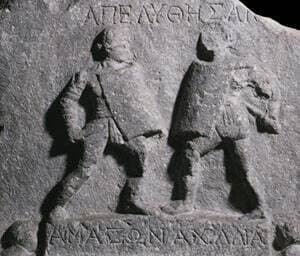
Very little is known about female gladiators. That alone tells you something important. If they had been common, Rome would have left behind a flood of evidence. Instead, what survives is thin: a few elite literary references, a handful of inscriptions, and very little visual material.[1] The silence is part of the story.
When female gladiators do appear in Roman writing, they are usually presented as novelties, what one historian summarized as “exotic markers of truly lavish spectacle.”[1] In other words, they were not standard entertainment. They were the extravagant extra, the thing an emperor or elite host staged to prove that the usual rules of expense, taste, and social order no longer applied.
That helps explain the contradiction at the heart of the gladiatrix. She was rare partly because Romans considered such public violence unwomanly.[1] And yet that very unwomanliness made her useful as spectacle. The shock was the product.
Rome’s Uneasy Fascination With Fighting Women
Roman culture had no problem enjoying women as spectacle. It had far more trouble with women performing aggression, endurance, and public physical risk in a coded male arena. A woman fighting in the amphitheater did not merely cross a line. She crossed one of the most symbolically loaded lines in Roman life.
That is why the surviving references often carry an edge of discomfort. Female fighters are described not as ordinary professionals but as symptoms of excess, decadence, or social inversion.[1] The point was never just that a woman fought. The point was that she fought there, before a crowd, in a role Romans strongly associated with masculinity, servitude, and danger.
By the early empire, women of low status could appear in the arena, but the participation of respectable or elite-born women was especially scandalous.[1] Rome did not simply fear violence. It feared disorder in status and gender. The arena could absorb blood. What it struggled to absorb was a woman acting in a way elite men thought no proper woman should.
Mevia And The Performance Of Shock
One of the most memorable female arena figures in Roman literature is Mevia, who appears in satire as a woman fighting wild boars with a spear, bare-breasted before the crowd.[1] It is an image designed to do several things at once. It sexualizes her. It humiliates her. It turns her into a symbol of social collapse. And, of course, it makes her impossible to forget.
The detail matters. A woman hunting boars in the arena was already transgressive. Doing so topless transformed the scene into something more than combat. It became a carefully engineered collision of sex, violence, and public shame, exactly the kind of thing Roman writers could use to signal that the world had become morally unsteady.
Later descriptions add another detail to Mevia: that she would squat to urinate in front of the crowd, an act meant not merely to scandalize but to obliterate every remaining boundary of feminine decorum. Whether treated as satire, smear, or spectacle, the point is the same: female arena performance fascinated Romans most when it could be framed as a total collapse of expected womanhood.
What The Sources Actually Show
The frustrating thing about female gladiators is that they are vivid and obscure at the same time. The sources prove they existed.[1] They do not give us enough to reconstruct a stable profession with the confidence we can for male gladiators. We know women fought each other or fought animals. We know they were unusual. We know audiences saw them as exotic rarities. We know Roman authorities eventually moved to restrict or ban such performances.[1]
That final point matters. You do not ban what does not exist. The very need for legal restrictions suggests that female arena fighting was real enough, visible enough, and troubling enough to attract official attention.[1]
So the gladiatrix occupies a strange place in Roman history. She was neither myth nor normality. She was real, but exceptional. Visible, but marginal. Recorded, but mostly by people who wanted to use her as a moral warning.
Why They Still Fascinate Us
Part of the fascination lies in the mismatch between scale and memory. Female gladiators were rare, yet they loom large in the modern imagination. That is because rarity concentrates meaning. A male gladiator can be a type. A female gladiator becomes a statement.
She tells us what Rome found thrilling. She tells us what Rome found offensive. And she tells us how thin the line was between those two reactions. The same culture that treated women in the arena as unwomanly also turned that unwomanliness into premium entertainment.
That is why Mevia lingers. Not because we know her life in any intimate sense, but because the image is so perfectly Roman: a woman with a spear, facing wild beasts, half fighter and half scandal, transformed into a story the culture could both consume and condemn.
The Woman In The Arena Was Never Just A Fighter
A male gladiator could be brave, doomed, skilled, expensive, famous. A gladiatrix was all of that plus something else. She was an argument.
Her body argued with Roman ideas about gender. Her presence argued with Roman ideas about respectability. Her rarity argued against the idea that the arena was a stable, orderly institution rather than a machine constantly pushing toward bigger shocks.
Female gladiators existed in ancient Rome. They were rare partly because Romans considered such behavior unwomanly.[1] But rarity did not make them trivial. It made them explosive. The arena was already where Rome went to watch limits break. A woman entering it simply broke a different kind of limit, and Rome could not stop staring.