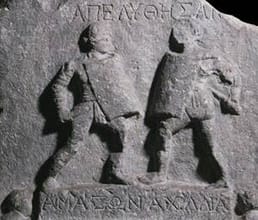
On a marble slab from the Roman world, two armed women face each other under borrowed names. One is called Amazon. The other is called Achillia. The inscription does not celebrate a killing. It says both fighters were released after a bout that ended in an honorable draw.[1]
Women did compete as gladiators in ancient Rome, and a marble relief from around the 2nd century A.D. preserves one striking case: “Amazon” and “Achillia,” two female fighters whose match ended with both earning honorable release.[1]
The names made the fight theatrical before the first exchange. Amazon pointed to the legendary warrior women of Greek myth. Achillia sounded like a female counterpart to Achilles, the hero whose name was tied to battlefield fame. Roman spectators were used to costume, rank, myth, and danger mixing in public games, and these two women were remembered as characters as well as combatants.[1]
The relief matters because the usual image of a Roman gladiator is too narrow. Many early fighters were enslaved people, conquered people, or condemned criminals, but by the 1st century A.D., grave inscriptions show that some free men were voluntarily signing contracts with gladiator schools for prize money, fame, and the roar of the crowd.[1]
Female gladiators belonged to that wider, stranger world of spectacle. They were rare, but they were real. Ancient writers mention women in the arena, and the Amazon and Achillia slab gives the fact a body: carved figures, names above them, and an outcome recorded in stone.[1]
A Fight With Funeral Roots
Gladiatorial combat began far from the huge public entertainment later associated with Rome. Ancient writers connected its origins to funeral rites, where bloodshed formed part of ceremonies for the dead. Over time, those combats grew into public games built around training, danger, display, and judgment.[1]
That background helps explain the arena’s contradictions. A gladiator could be socially degraded and still admired for courage. A fighter could be enslaved and still become famous. A free person could enter a gladiator school by contract, surrendering freedoms for the chance at reward.[1]
A woman fighting in that setting would have carried an extra charge. Roman society did not treat armed women as ordinary public figures. A fighter introduced as Amazon was stepping into a masculine arena while wearing the name of a mythical warrior people famous for unsettling male heroes.[1]
The Draw That Survived
The inscription’s important detail is the ending. Amazon and Achillia were not recorded as victor and corpse. They were released after an honorable draw, which means the match was remembered as a performance in which both women had done enough to be spared.[1]
That is a useful correction to the blunt modern picture of gladiatorial games as simple slaughter. The arena was violent, but it also had categories, reputations, staged identities, trained fighters, and decisions about when a contest had satisfied its purpose.[1]
Most of that world vanished as soon as the crowd noise faded. Contracts decayed. Sand was swept clean. Wooden equipment broke or was replaced. What remains here is stone: two women still facing each other, their arena names overhead, their draw made permanent.[1]