When Charles Dickens's pet raven fell ill in March 1841, a dose of castor oil produced an encouraging result: the bird recovered enough to bite the coachman. Dickens recorded the improvement in a letter about Grip, whose habits he had been watching closely for a novel. Biting was familiar behavior in this particular household, and the return to it briefly suggested that the patient was getting better.[1][2]
A few weeks earlier, on January 28, Dickens had explained his plans to the artist George Cattermole. The central character in Barnaby Rudge would have a raven companion considerably cleverer than himself, and Dickens was studying his own bird to see what he could make of it. Grip supplied him with plenty to observe, including a vocabulary, a fondness for ankles and a collection of halfpence buried around the garden.[1][2]
By March 12, the day Grip died, those familiar habits had worked their way into Dickens's account of the illness. Writing to his friend Daniel Maclise, he described the bird talking about the horse and the coachman's family, then treated its less intelligible remarks as possible instructions for disposing of its property. The halfpence in the garden had become a little estate, and the raven's final hours received the elaborate attention of a deathbed biography.[1]
After the encouraging bite, Grip had passed a peaceful night and eaten warm gruel the next morning, but the improvement had not lasted. Dickens reported that the bird walked along the coach-house, stopped to bark, said its favorite phrase, "Halloa old girl!", and died. He wondered whether white paint swallowed the previous summer had something to do with the illness and ordered a post-mortem examination. His letter does not establish the cause of death.[1]
Dickens asked Maclise to pass the news to John Forster, explaining that he could not bear to write it twice. He sustained the ceremonious sorrow almost to the end, where the children received a rather different obituary: "The children seem rather glad of it. He bit their ankles. But that was play." Even while reporting their relief, their father was making allowances for the bird.[1]
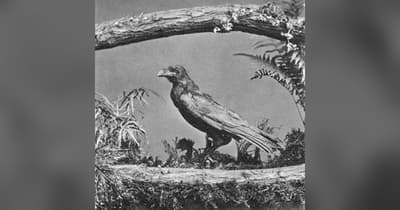
With Grip dead, Dickens arranged for a taxidermist to preserve the raven in a case of wood and glass for his study. He also obtained another raven, older and larger, which went to live in the stable under the same name. Forster wrote that this second Grip arrived almost before the first one's stuffed remains came home, allowing Dickens to keep his pet and continue his observations of a living bird.[1][2]
The fictional Grip soon acquired an admirer in Edgar Allan Poe, who enjoyed the raven in Barnaby Rudge. Poe published The Raven in 1845, and scholars have often linked his bird to Dickens's. Lucinda Hawksley's BBC account preserves an important qualification: there is no concrete proof that Grip inspired the poem.[2]
The preserved bird eventually acquired a place among books as well. In 1999, Grip received a Literary Landmark dedication at the Free Library of Philadelphia's Rare Books Department. Alongside the writings of the two authors, a library could preserve the bird itself: Dickens's household companion, mounted in its glass case.[2][3]
Sources
- John Forster, The Life of Charles Dickens, Volume I, Chapter XIV
- Lucinda Hawksley, The Mysterious Tale of Charles Dickens's Raven, BBC
- American Library Association, Literary Landmark: Grip the Raven
Image: Archival photograph of the preserved Grip, August 1870, George Swan Nottage / London Stereoscopic & Photographic Co.; public domain, via Wikimedia Commons. Existing crop by Gobonobo and Ubcule; enlarged with blurred side extensions.