Charles Dickens had already climbed out of the carriage when he remembered the pages. Around him, passengers lay hurt beside the wreckage near Staplehurst, Kent. His first-class coach had not fallen like the others, but it was hanging at a steep angle from the bridge, and inside it was the latest installment of Our Mutual Friend.[3]
In the 1865 Staplehurst rail crash, Charles Dickens survived a derailment near Kent, helped injured passengers for hours, then returned to his damaged carriage to recover the manuscript of Our Mutual Friend.
The train was carrying Dickens back from France on June 9, 1865, with Ellen Ternan and her mother in the same first-class carriage.[2] It was the Folkestone to London boat train, a service tied to ships arriving from the continent, so its timing could shift with the tides rather than follow an ordinary fixed schedule.[5]
Near Staplehurst, workmen were repairing the railway over the River Beult. The job required removing iron rails so rotten wooden timbers beneath them could be replaced.[3] By the time Dickens’s train approached, a section of track over the bridge was gone. One account gives the gap as 42 feet long.[4]
A man with a red flag had been placed ahead of the work, but not far enough ahead. The Board of Trade report found that regulations required a warning 1,000 yards from the danger; the signalman was only about 554 yards away, leaving the train too little distance to stop.[2] Another reconstruction says the train was approaching at about 50 miles per hour when the warning was seen.[3]
The carriage that stayed on the bridge
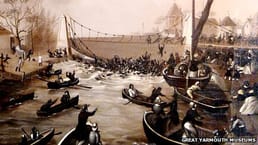
The engine and the first part of the train crossed the break, carried forward by momentum.[4] The middle and rear coaches dropped into the river bed below.[4] Ten passengers were killed, and about 40 were injured.[2] Dickens’s carriage became the narrow exception among the first-class coaches. It did not plunge into the ravine. It hung from the bridge instead, sharply tilted, with Dickens, Ternan, and her mother still alive inside.[4]
Dickens was 53 years old. After getting the Ternans out, he turned toward the injured passengers around the wreck.[4] He retrieved a flask of brandy and his top hat from the train, filled the hat with water, and moved among the survivors doing what he could to comfort them.[4] One injured woman resting under a tree accepted brandy from him; when he passed her again, she was dead.[4]
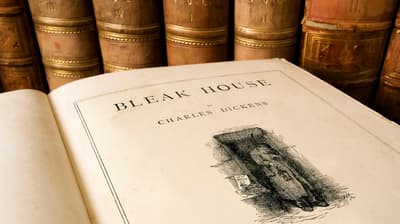
For roughly three hours, Dickens remained at the scene, helping until aid arrived and the wreck was being cleared.[4] Then he remembered what was still in his compartment. The manuscript of Our Mutual Friend, the novel he was publishing in installments, had been left inside the damaged carriage.[4] He climbed back into the wreck one last time and recovered it.[4]
The pages that survived with him
Dickens later folded the accident into the postscript to Our Mutual Friend. He wrote that on Friday, June 9, “Mr. and Mrs. Boffin,” in their manuscript form, had been on the South Eastern Railway with him and had shared the danger.[4] The line is almost jaunty, but the crash stayed with him.
After Staplehurst, Dickens avoided railway travel as much as he could, and later confessed that he still suffered “sudden vague rushes of terror.”[3] Modern researchers have suggested he experienced post-traumatic shock.[3] He died of natural causes exactly five years after the crash, on June 9, 1870.[3]
What remains is not only the famous survivor, but the object he went back for: a sheaf of pages in a wrecked carriage, the next piece of a novel waiting above the broken bridge.