Andrew Young walked into a ground-floor room at the Lorraine Motel in Memphis around 4 p.m. on April 4, 1968, after a full day on the witness stand in federal court [11]. Martin Luther King Jr. was inside with his brother, A.D. King, and Ralph Abernathy, co-founder of the Southern Christian Leadership Conference, working through a tray of catfish and sweet tea [1][11].
Young had been in court since 9 a.m., challenging an injunction that blocked a second march [11]. He had testified to get a restraining order lifted so King could lead a demonstration for the city's striking sanitation workers, who had walked out in early February [1][6]. Memphis paid Black sanitation workers about $1 an hour, issued no uniforms, provided no restrooms and recognized no union or grievance procedure [2]. Two workers had been crushed by a malfunctioning garbage truck on February 1, 1968, and the strike began on February 12 [2].
King opened with a complaint. “Where have you been? You haven't called me all day long,” Young recalled him saying [1]. Young answered that he had been on the witness stand trying to win King the right to march and keep him out of jail [1]. The Atlanta Journal-Constitution's retelling has King mocking agitation as he demanded an accounting of the day [7]. Then he told Young he was getting smart with him, picked up a pillow and threw it [1]. A.D. King and Abernathy took up pillows too, and the room became, in Young's phrase, a bunch of 12-year-olds [1]. In his 1996 memoir An Easy Burden, Young wrote that King and Abernathy each lifted a pillow and pummeled him [8].
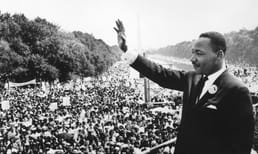
Forty years after the shooting, Young said the playfulness was what stayed with him. “What I remember most vividly about Martin,” he said in 2008, “is his sense of humor. He was an incredible, fun-loving, happy young man” [10]. A Time account of four surviving aides recorded that King was less melancholy that afternoon than he had been [12]. The night before, fighting a cold and fever, he had given the “I've Been to the Mountaintop” speech at Mason Temple to a crowd that filled the church and stood outside in the rain [9][11].
A knock ended the fight. The Rev. Samuel Billy Kyles, a Memphis minister, told the group they were late for dinner at his house, and King said he would go upstairs and put on his shirt and tie [1]. The corner room downstairs had been King's originally. Memphis police had asked the hotel manager to move him to the second floor because they thought they could guard him better there, Young said [1][6]. “He couldn't have been shot in that downstairs room,” Young said [1].
Young waited in the parking courtyard below while King came out onto the second-floor balcony of Room 306 and hesitated over whether to fetch a topcoat [10][12]. Young had told him it was still cool and he had a cold [10][12]. He heard a noise he took for a firecracker [10]. King was shot at 6:01 p.m. Central Standard Time and pronounced dead at St. Joseph's Hospital at 7:05 p.m. He was 39 [2].
James Earl Ray, an escaped convict from the Missouri State Penitentiary, was arrested at London Heathrow Airport on June 8, 1968, and extradited to the United States [2]. He pleaded guilty on March 10, 1969, and was sentenced to 99 years in the Tennessee State Penitentiary, later failing in repeated attempts to withdraw the plea [2]. King had been jailed several times and had faced death threats since the mid-1950s [2][3]. At his death he was organizing the Poor People's Campaign, a planned national occupation of Washington, D.C. [3].
The Lorraine Motel is now the center of the National Civil Rights Museum at 450 Mulberry Street [5]. Walter Bailey bought the 16-room property in 1945 and named it for his wife Loree and the song “Sweet Lorraine”; he added a second floor and a swimming pool in 1964 [5]. The museum reopened in 2014 after renovations and became a Smithsonian affiliate in 2016 [5]. Young, the SCLC's executive director from 1964, later served in Congress, as ambassador to the United Nations and as mayor of Atlanta [4].