
At 4 p.m. on September 6, 1901, William McKinley stood inside the Temple of Music on the grounds of the Pan-American Exposition in Buffalo, New York, and began shaking hands with a line of visitors. An organist played a Bach sonata as the crowd filed slowly past [6]. The president was six months into his second term [1].
The fair that hosted him opened on May 1, 1901, and ran through November 2 across 350 acres on the western edge of what is now Delaware Park [5]. Organizers called it the Rainbow City, and its buildings were lit with alternating current generated 25 miles away at Niagara Falls [5]. More than 8,000,000 visitors came during the run [5].
George B. Cortelyou, the secretary to the president, had struck the Temple of Music reception from the schedule twice, and McKinley had restored it both times [1]. McKinley disliked having security personnel between himself and the public; in Canton, Ohio, he often walked to church or the business district without a guard [1]. Police and soldiers joined his usual Secret Service agents inside the hall that afternoon [6].
An opponent gave McKinley a red carnation boutonniere to wear during a debate early in his political career. He won the debate and the congressional election that followed, and he treated the flower as a good luck charm from then on, wearing one through his gubernatorial and presidential campaigns and keeping a bouquet of them on his desk in the Oval Office [9]. Fragrance-free carnation cultivars are the ones commonly sold as men's boutonnieres [2].
Near the front of the line stood Myrtle Ledger, a 12-year-old girl who had come to the fair with her mother. McKinley handed her the flower from his lapel and said, "I must give this flower to another little flower" [8][9]. She remembered the exchange years afterward [9].
Three feet behind her in the line stood Leon Czolgosz, a 28-year-old former steel worker [6][7]. Born in Detroit on May 5, 1873, to Polish immigrant parents, he had lost his job in the labor turmoil that followed the Panic of 1893 and moved from a moderate socialist club into anarchism [1][4]. A lecture by Emma Goldman in Cleveland in May 1901 left him, by his own account, set on fire [4][7]. Other radicals grew suspicious of his awkward questions, and the newspaper Free Society printed a warning on September 1 describing a possible spy [4]. Days earlier he had bought a .32 caliber Iver Johnson revolver and carried it wrapped in a white handkerchief [6][7].
Czolgosz fired twice as McKinley reached for his hand. One bullet grazed the president; the other entered his abdomen and was never found [1]. James Parker, a 6-foot-4-inch man from Georgia, struck Czolgosz in the neck and brought him down, and the crowd began beating the gunman [8]. McKinley, seated and bleeding, called out, "Don't let them hurt him" [8].
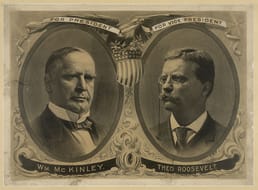
McKinley appeared to be recovering until September 13, when his wounds turned gangrenous. He died at 2:15 a.m. on September 14, and Vice President Theodore Roosevelt succeeded him [1][3]. Czolgosz was convicted of first degree murder a month later and executed in the electric chair on October 29 [1][4]. Congress later passed legislation formally charging the Secret Service with protecting the president [1]. In 1904 the Ohio General Assembly named the scarlet carnation the state flower in McKinley's honor [9].