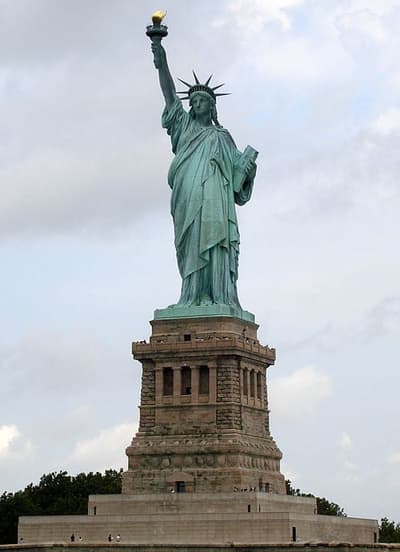
On October 28, 1886, President Grover Cleveland presided over the dedication of the Statue of Liberty on Bedloe's Island in New York Harbor, an event preceded by the city's first ticker-tape parade [1]. The copper figure, designed by Frédéric Auguste Bartholdi with a metal framework by Gustave Eiffel, was a gift from the people of France [1]. The statue itself arrived paid for. The granite base beneath it was funded separately, largely by newspaper readers sending small amounts of cash.
Under the arrangement settled in 1875, France would finance the statue while the United States supplied the site and built the pedestal [1]. The American Committee of the Statue of Liberty formed in 1877 to raise the pedestal money, a granite plinth budgeted at $250,000 [7][8]. The committee campaigned for years and fell short by more than a third of that sum [7].
By the summer of 1885 the statue was in New York, crated in 350 individual pieces, with no pedestal waiting for it [8]. New York Governor Grover Cleveland refused to let city funds pay for the base, and Congress could not agree on a funding package [7][8]. Baltimore, Boston, San Francisco and Philadelphia each offered to cover the cost if the statue were moved to their harbor instead [7][8].
On March 16, 1885, the New York World ran a front-page appeal from its publisher, Joseph Pulitzer [6][8]. "We must raise the money," the paper wrote, arguing that the $250,000 for the statue had come from French working men, tradesmen and shop girls, and that Americans should respond in kind rather than wait for millionaires [6][8]. Pulitzer promised to print the name of every contributor, whatever the amount [3][9].
Donations came from children, businessmen, street cleaners and politicians [7]. Philip Bender of Jersey City sent $2.65, itemizing fifty cents each for himself and his wife and smaller amounts for each of their children [7]. Jonathan Sooville, the mayor of Buffalo, gave his $230 annual salary, while 43 wealthy New Yorkers each offered $250 [7]. The World offered a six-inch replica of the statue to anyone giving a dollar and a twelve-inch replica for five dollars [8].
By August 11, 1885, the World had collected more than $100,000 from about 125,000 people, most of whom gave a dollar or less [3][6]. The BBC put the total at $101,091 raised in five months from more than 160,000 donors, three-quarters of them giving under a dollar, with enough left over for a gift to the sculptor [7]. The National Park Service counts the drive as six months of fundraising [6].
The statue was assembled on the finished pedestal and dedicated in 1886 [1]. Pulitzer had bought the World in 1883 and used it to build circulation through scandal, sports and sensation, the mix that came to be called yellow journalism [2][3]. His will left money to Columbia University for prizes in journalism, letters and other fields, first awarded in 1917 [2].
In 2013 the BBC compared the World's drive to campaigns run on Kickstarter and Indiegogo, citing the single collection point, the speed and the large number of small donations [7]. A history of crowdfunding records that in 1885 a newspaper-led campaign drew small donations from 160,000 donors after government funding failed [4]. The statue was declared a national monument in 1924, and the National Park Service has maintained it since 1933 [1][5]. Congress renamed Bedloe's Island Liberty Island in 1956, and a plaque added in 1903 carries Emma Lazarus's poem "The New Colossus" [5]. Visitors can climb 154 stairs to the crown, capped at 240 people a day, though the torch has been closed since 1916 [1][5].