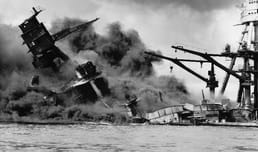
At 7:48 a.m. Hawaiian time on December 7, 1941, 353 Japanese fighters, dive bombers and torpedo planes attacked Pearl Harbor in two waves launched from six aircraft carriers [2]. All eight US battleships in the harbor were damaged and four were sunk, and 2,403 Americans were killed [2]. Armor-piercing bombs hit USS Arizona, one of them detonating a magazine; 1,177 of the ship's officers and crew died, and the wreck was never repaired for wartime service [5].
The Navy removed Arizona's wrecked superstructure after the war and began planning a memorial at the submerged hull. A 10-foot basalt stone and plaque went over the midship deckhouse on December 7, 1955, and President Dwight Eisenhower approved a national memorial in 1958 [3]. Enabling legislation set the budget at $500,000, required private financing and left $200,000 of the cost to the government [3]. By 1960, less than half of the money had been raised [1].
On December 4, 1960, Colonel Tom Parker read a Los Angeles Examiner editorial about the stalled memorial fund [7]. Parker, who managed Presley, thought a benefit concert would bring his client good publicity, and the singer agreed [1]. At a January 11, 1961 press conference at the Hawaiian Village Hotel in Honolulu, Parker announced the show and set the terms: every penny taken in would go to the fund [7]. H. Tucker Gratz, chairman of the memorial fund commission, said no living soul would get a free ticket, performers included [7].
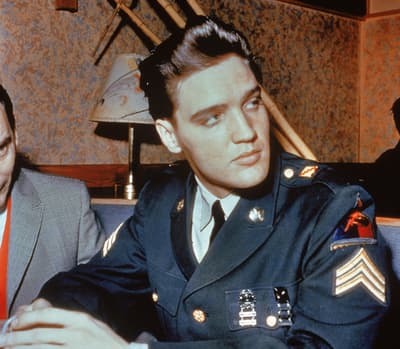
Presley had been honorably discharged from the Army in the spring of 1960, a year before the concert [1]. His last concert before induction had been in Hawaii on November 11, 1957, for service members and their families [1]. At the press conference Parker noted that Presley was 26, about the average age of the sailors entombed in the Arizona [7].
Parker first scheduled the concert for March 26, 1961, then moved it to Saturday, March 25, at Bloch Arena on the Pearl Harbor base [7]. Of 4,000 seats, 300 ringside seats sold for $100 each and the rest were scaled from $3 to $10 [7]. When Presley landed at Honolulu International Airport, about 3,000 people were waiting; Jimmy Stewart, on the same plane, drew little attention [1].
Four thousand fans filled Bloch Arena on the night of March 25, 1961, and Presley wore the gold lamé suit jacket he had first worn in 1957, for the last time [1]. It was only his second live performance in more than three years [1][6]. Ticket sales brought in just over $54,000 [7].
The memorial fund later counted $64,000 from the concert, part of a total that included $50,000 from the Territory of Hawaii in 1958, $95,000 raised after a This Is Your Life television segment, $40,000 from sales of plastic Arizona models and $150,000 in federal money secured by Senator Daniel Inouye in 1961 [3]. The memorial was dedicated on May 30, 1962 [7]. Architect Alfred Preis designed the 184-foot structure, which straddles the sunken hull without touching it and draws more than two million visitors a year [3].
Presley did not perform live again until his 1968 NBC television special [3]. The 1973 broadcast Aloha from Hawaii, the first concert by a solo artist shown around the world, was a separate project with no role in the memorial fund [4].