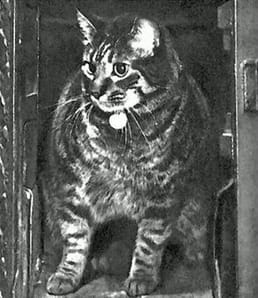
On October 7, 1897, New York's new mail tube took its ceremonial cargo seriously at first. Senator Chauncey Depew sent a Bible wrapped in an American flag, a copy of the Constitution, President McKinley's inaugural address, and other papers from the old General Post Office toward the Produce Exchange. The return trip brought violets. Then the jokes started. A peach came back, because a crowd once called Depew "a peach." After that, postal workers put a live black cat into the carrier and shot it under lower Manhattan.
New York's pneumatic mail system opened in 1897 with patriotic papers, flowers, and finally a live cat. The animal survived the underground trip, a very Gilded Age way to prove that mail could move faster than a person walking across town.
Howard Wallace Connelly, a postal supervisor who later wrote about the episode, still sounded a little stunned decades afterward. The cat had been fired from Station P in the Produce Exchange Building, made several turns, and arrived at Broadway and Park Row. "How it could live," he wrote, "I cannot conceive, but it did." It was dazed for a minute or two, then tried to run before workers secured it in a basket.[1]
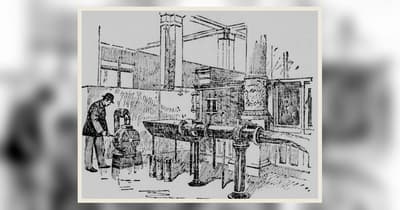
The first route ran about 3,750 feet between Park Row and Bowling Green. A carrier could hold hundreds of letters, and the National Postal Museum says pneumatic canisters traveled at an average of 35 miles per hour. By 1915, six American cities had more than 56 miles of tubes pulsing below the streets.[2] The cat prank worked because a working city machine sat behind it, fast enough to turn a city office into a stage.
Newspaper accounts and later histories describe the inaugural dispatch as a kind of civic magic trick: a Bible, federal documents, flowers, a joke peach, then an indignant animal proving the tube did not care what nineteenth century people decided to call mail.[3] The same system eventually became ordinary enough that operators had a nickname, "Rocketeers," and the network grew to 27 miles connecting 23 post offices.[4]
At its peak, the New York tubes carried about 95,000 letters a day, roughly 30 percent of the city's mail.[1] The cat story can sound like a footnote from a city that had too much confidence and too few animal welfare meetings. It also exposed a real anxiety. New York was getting too large for old habits. Streets jammed. Offices multiplied. Messages had to cross a city that kept inventing new ways to be late.
The tubes lasted until 1953, long after the joke had vanished into postal lore. Automobiles, cost, repairs, and changing mail volumes made the underground system harder to defend.[4] What remains is the image of a steel cylinder arriving at the counter, a lid opening, and a black cat deciding that the future had been quite fast enough.