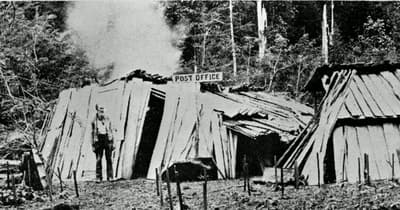
The sign over the doorway said POST OFFICE, although the doorway was cut into a cedar stump.
In the late 1800s, some Pacific Northwest settlers reused giant logging stumps as actual rooms, including a Washington post office whose main room was carved inside a hollow cedar stump 143 feet around near the ground.
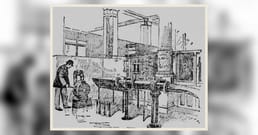
In an 1897 photograph preserved by Washington Rural Heritage, a man stands beside the McDonald Post Office near Port Angeles, Washington, with rough split boards leaning against a swollen cedar base and forest still crowding the background. The printed caption does the work a joke would usually do: the main room was a hollow cedar stump, and the stump measured 143 feet in circumference near the ground.[1]
The photograph needs the standing man because the measurement alone feels absurd. Someone needed mail. Someone else needed a place to sort it. On the eastern side of the Elwha River, where roads were thin and settlement was still being improvised, the leftover base of a tree became enough architecture to hold a federal routine.
The stump room belonged to a wider, stranger habit of the logged West. A tree could be too large to disappear neatly. Once the marketable trunk was gone, the base remained as a wall, a shed, a curiosity, or a shelter. Messy Nessy's Cabinet, collecting photographs and local accounts, describes stumps turned into huts, animal shelters, hotel attractions, dance floors, and homes across Washington, Oregon, and California.[4]
In Calaveras County in 1866, a photographer found three people seated inside a house built on the Original Big Tree Stump.[2] The room looks less like wilderness romance than domestic adaptation: chairs, walls, people posing where a living tree had recently stood. By 1920, another Library of Congress photograph showed the Pacific Highway running through a Washington red cedar stump 20 feet in diameter, with a man and automobile placed inside the tunnel for scale.[3]
In those pictures, the front doors and road cuts make the stumps feel both ingenious and bruising. A stump should not have a doorway, and the doorway exists only after a giant tree has been cut down. The same object can look thrifty, boastful, desperate, and careless, depending on whether you notice the postmaster, the ax, the road, or the missing canopy first.
On logged farms, a huge cedar base could remain in the ground after the saleable trunk had gone away. Pulling it out could take money, animals, tools, and time. A hollow one already had walls. Add a roof, boards, paper, a stove, or a sign, and the problem briefly changed shape.
In the McDonald photograph, the strangest object may be the ordinary sign nailed above the opening. Letters arrived. Names were sorted. Neighbors stopped at a stump because that was where the mail was. A forest had been cut into lumber, roadbeds, and cleared acres, yet one enormous root end still stood there, big enough to borrow for government work.
After the split coverings came off, the caption says, the stump remained on Bertha M. Hartt's ranch.[1] The post office costume was gone. The cedar base went back to looking like a remnant. For a while, though, people walked up to a tree stump and expected the ordinary miracle of a letter waiting inside.
Sources
- Washington Rural Heritage, "McDonald Post Office with caption, Clallam County, Washington 1897"
- Library of Congress, "Interior of the house built on the Original Big Tree Stump, Calaveras County"
- Library of Congress, "Pacific Highway through a Washington red cedar stump, 20 feet in diameter"
- Messy Nessy's Cabinet, "When Americans Lived in Tree Stumps"