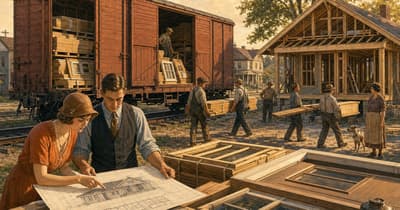
For a few decades in America, you could buy a house almost the way you bought socks or farm tools: by opening a Sears catalog and picking the model you wanted.[1]
From 1908 to 1940, Sears sold tens of thousands of mail-order homes, offering more than 370 designs ranging from modest bungalows to large Colonials.[1][2] The promise was startlingly modern. Your future house would arrive by rail as a giant kit, complete with blueprints and most of the materials needed to build it.[1][2][3]
This was not a crate with a few boards inside. A typical Sears kit house contained more than 30,000 parts and could weigh about 25 tons.[2][3] After 1916, many came with precut lumber stamped with letters and numbers so builders could match each piece to the plan, a change Sears said could cut construction time by as much as 40 percent.[2][3] Windows, doors, shingles, millwork, and hardware could all be part of the order, and buyers could get houses with indoor plumbing, central heating, and electricity at a moment when those comforts still felt new in many places.[1][2]
The bigger idea was not just the house itself. Sears was helping turn homebuilding into a retail system: standardized, financed, and shipped at scale.[2] The company began offering financing in the 1910s, which meant some buyers were not just ordering a house from a catalog. They were ordering the mortgage, too.[2]
The strange part came later. Sears destroyed many of its Modern Homes sales records, so historians and homeowners now have to authenticate surviving houses through old mortgages, deeds, plan matches, and the stamped lumber still hiding in basements and attics.[2][3] That matters because not every early-20th-century bungalow is a Sears house. Researchers at SearsHouses.com estimate that only a small fraction of homes built during the kit-house era came from Sears at all.[3]
That is why the story still lands. Long before one-click shopping, Sears turned the biggest purchase of most people’s lives into something that looked almost routine. You picked a model, waited for the railcar, and built a future out of numbered boards. Plenty of those houses are still standing, which means some of America’s most ordinary-looking homes are really mail-order survivors.[1][2][3] In some neighborhoods, people may be walking past former catalog listings without realizing it.