On a blistering Sunday in July 1941, 80 Army trucks crawled through Memphis traffic carrying 350 soldiers of the 110th Quartermaster Regiment. The men had just finished a grueling month of maneuvers across central Tennessee. Ties were off, collars open, and the mood was loose. Then they passed the Memphis Country Club, where a group of women in shorts were strolling along the sidewalk.[1]
What happened next would spark a congressional firestorm, earn a decorated general a nickname he'd never shake, and force America into its first real argument about how a modern military should treat its citizen soldiers.
The troops did what troops have done since Rome: they whistled, catcalled, and yelled "Yoo-hoo!" at the women. One soldier spotted a leathery-faced golfer lining up on the first tee and shouted, "Hey buddy, do you need a caddy?"[1]
That golfer was Lieutenant General Benjamin Lear, commander of the entire U.S. Second Army.
Lear vaulted a three-foot fence, stormed the convoy, and delivered what TIME Magazine described as a dressing-down that "sizzled with first sergeant's wrath." He told the officers their men had disgraced the Army, then sent them on their way with a promise: they'd hear from him soon.[1]
The punishment arrived that evening at Camp Robinson, Arkansas. Every man in the 110th was ordered to turn around and drive 145 miles back to Memphis, immediately. They rolled out toward midnight, stopped for three hours so exhausted drivers wouldn't crash, and by noon the next day were pitched in tents at the Memphis airport, waiting.[1]
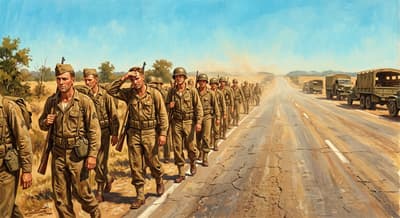
Then came the sentence: on the return trip home, every soldier would march 15 miles on foot, in rotating five-mile shifts, while their trucks leapfrogged ahead. This was a quartermaster unit, not infantry. These were truck drivers, clerks, typists, and mechanics. And it was 97 degrees, the hottest day in two years.[2]
About a dozen men collapsed from the heat. The only medical support available came from a dentist and a sanitary officer who were also being punished. When civilians weren't watching, the soldiers tried to improvise a marching song: "General Lear, he missed his putt, parley voo..."[1]
Congress erupted. Texas Representative Paul Kilday fired off a telegram demanding an explanation. Everett Dirksen wondered aloud whether "public funds are to be expended so that grouchy, golfing old generals will develop a lot of sourpuss soldiers." Missouri Senator Bennett Champ Clark called Lear "a superannuated old goat who ought to retire."[1]
It became, as TIME put it, "the first time U.S. citizens had had a chance to make a song and dance out of anything connected with World War II, and they made the most of it."[1]
The commander of the 35th Division, which the 110th fell under, was Major General Ralph E. Truman. His cousin? Senator Harry S. Truman, the future president.[2] The political pressure to punish Lear was intense. But the Army backed him. In their eyes, orders are orders, and a general is always right. Lear was no desk jockey. He'd enlisted as a private in 1898 and fought his way to three stars.[2]
None of that mattered to the public. The nickname "Yoo-Hoo" followed Lear for the rest of his career. His official military photos in the National Archives are literally cataloged under "LTG Ben 'Yoo Hoo' Lear."[2]
The George C. Marshall Foundation considers the Yoo-Hoo Incident a revealing snapshot of a country wrestling with a question that still hasn't been fully answered: when you draft civilians into an army, how much of their civilian identity do they get to keep?[3]
The 350 men of the 110th Quartermaster Regiment marched their 15 miles in the Arkansas heat, stumbled back to camp, and took the ribbing in stride. The nation yoo-hooed in solidarity. And Ben Lear went right on playing golf.