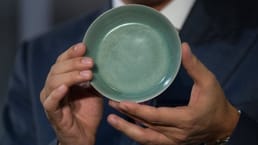
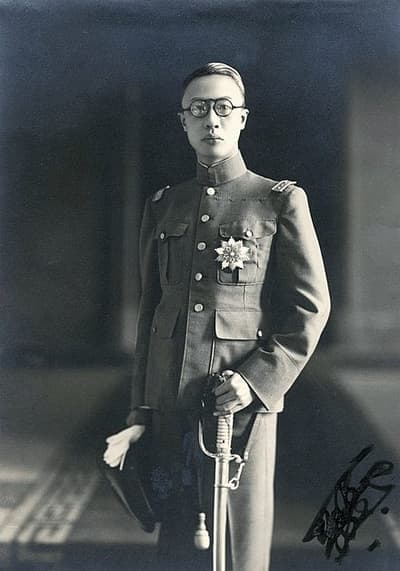
Imagine walking through a museum. You stop in front of a jade vase or a ceremonial silk robe and read the small plaque: "Item recovered from the Qing Dynasty, circa 1900." For most, that object is a relic of a distant, dusty history. But for one man, that object wasn't an artifact. It was his breakfast bowl. It was his bedsheets. It was the very fabric of his childhood.
This was the surreal, almost cinematic reality of Puyi. He didn't just study history; he was once its living, breathing center. Then, in a dizzying turn of geopolitical tides, he was cast out of it.
The Boy Who Was a God
In 1908, a two-year-old boy ascended a throne held by his ancestors for centuries. Puyi became the Xuantong Emperor, the eleventh and final ruler of the Qing dynasty[1]. At an age when most children are learning to tie their shoes, Puyi was navigating a world of rigid ritual, bowing subjects, and the stifling, gilded isolation of the Forbidden City.
He was, for all intents and purposes, a god on earth. But the world outside the palace walls was screaming for change. The Xinhai Revolution was tearing through the foundations of imperial China, and by February 1912, the boy-emperor was forced to abdicate[1]. The dynasty was dead, but the ghost of the monarchy lingered in the corridors of the palace, where Puyi remained a prisoner of his own status—a monarch without a country, living in a museum of his own former life.
A Life in the Shadows of Giants
History rarely allows a man like Puyi to simply fade away. His life became a series of strange, often tragic, reinventions. In 1917, he was briefly restored to the throne by a loyalist general, a fleeting moment of reclaimed glory that lasted only twelve days[1]. By 1924, he was expelled from the Forbidden City entirely, forced to find refuge in Tianjin.
It was during this period that Puyi’s life took its most controversial turn. Caught between warring Chinese factions and the encroaching influence of the Japanese Empire, he made a choice that would define his legacy: he became the nominal ruler of Manchukuo, a puppet state established by the Japanese during World War II[1]. It was a desperate attempt to reclaim power, but it ultimately relegated him to the role of a political tool, used by a foreign power to legitimize an occupation.
The Emperor and the Street Sweeper
The most jarring chapter of Puyi’s story, however, isn't found in the high-stakes politics of Manchukuo, but in the quiet, humbling aftermath of his downfall. After the war, Puyi underwent a radical transformation. The man who once commanded millions was stripped of his titles, imprisoned, and eventually "re-educated" under the new Communist regime[1].
The transition was absolute. The celestial being became a citizen. The man who once had servants to dress him and eunuchs to attend his every whim eventually found himself performing the most mundane of tasks: working as a gardener and a street cleaner[1].
There is a profound, almost haunting irony in this descent. It is a story of total inversion. The man who once owned the very ground the people walked upon was now tasked with sweeping it clean. Yet, even in this diminished state, the connection to his past remained unbroken. It is said that Puyi would occasionally visit the Forbidden City as a common tourist. He would wander through the crowds, a man among many, pointing at the exquisite treasures behind glass and whispering to himself about the objects he once owned[1].
He was a man living in two worlds at once: the mundane reality of a citizen in a new China, and the phantom memory of an empire that had vanished, leaving him as its only living monument.