Lay out the remains of a medieval longbowman, and the weapon can appear without any wood or string surviving beside him.
The left arm may be enlarged. The shoulder may carry the rough history of repeated strain. The left wrist can show bone spurs. The right fingers, the ones that hauled the bowstring back again and again, may keep their own marks from the pressure of the draw.[1] Centuries after the bow rotted away, the skeleton could still describe the work.
That is the unnerving part of the English war bow. A longbowman did not simply learn a technique and take it to war. He grew into the weapon. Years of practice with heavy bows could make the body asymmetrical, thickened, and permanently changed.
A Bow You Had To Grow Into
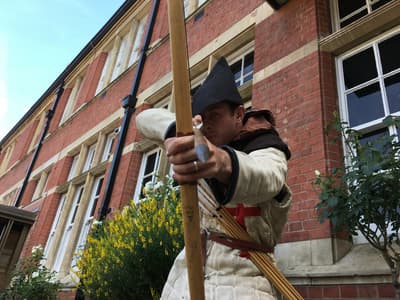
A war bow could stand nearly as tall as the man who used it. Descriptions of medieval longbows place typical examples around five feet ten inches to six feet six inches, with some longer still.[2] Many were made from yew, using a single stave that combined the harder heartwood with the more flexible sapwood of the tree.[3]
The hard part began before the arrow flew. Medieval longbows often had draw weights exceeding 50 kilograms, or more than 110 pounds.[1] Other accounts of war bows give ranges from about 100 pounds to more than 180 pounds.[3] A person could not fake that strength. The body had to be trained until pulling the bow became possible at speed.
English and Welsh archers became famous because that training started early. Medieval laws and customs encouraged boys and men to practise archery, helping create a reserve of trained bowmen for war.[3] A skilled archer could loose about ten arrows a minute, with some accounts putting the rate at ten to twelve.[2] In massed ranks, that meant the battlefield effect began years before Crécy or Agincourt, in the repeated pull of boys becoming soldiers.
The Marks Left In Bone
Bone changes under pressure. The principle often called Wolff’s Law describes how bone remodels itself in response to repeated load, strengthening where force is applied again and again.[3] The longbow gave medieval skeletons an extreme version of that process.
Archaeological discussions of longbowmen describe thickened bones, enlarged muscle attachment areas, and changes around the shoulder, clavicle, and scapula.[4] The bow arm and drawing side did different jobs. One side held the weapon steady. The other dragged the string back under a load heavy enough to defeat many modern beginners before a clean shot was ever loosed.
Some accounts describe increased cortical bone thickness in the drawing arm and torsion in the humerus, a twist linked to the torque of heavy bows.[4] Others summarize the pattern more bluntly: enlarged left arms, bone spurs on the left wrists and shoulders, and changes in the right fingers from the string.[1] These were adaptations, but they were also damage in the plain sense. The skeleton recorded a lifetime of force.
That is why the remains of longbowmen can be so distinctive. A profession can survive in a shoulder joint. It can sit in a wrist roughened by stress, or in fingers altered by the same narrow pressure applied thousands of times.
The Commoner Behind The Arrow Storm
At Crécy in 1346 and Agincourt in 1415, English armies used massed archers to help disrupt and devastate French forces.[3] The familiar picture is dramatic: a yeoman with a yew bow sending arrows into armoured knights. The quieter machinery behind that picture was a system that turned ordinary men into specialized bodies.
The longbow was simple in outline, a stave, a string, an arrow. The human part was more costly. It required practice, law, muscle, pain, and enough repetition for the skeleton to answer back.
Gunpowder weapons eventually changed the battlefield, and longbow units faded as firearms such as arquebuses became more common.[1] The legends lasted, with Robin Hood, yew staves, and arrow storms. The colder evidence is smaller and more persuasive: a widened shoulder, a roughened wrist, and fingers that still seem to remember the string.