NASA once took a very serious interest in a question you would normally hope never comes up at work: what happens if an astronaut farts in a sealed capsule?[1]
In 1964, at a NASA-sponsored Conference on Nutrition in Space and Related Waste Problems in Tampa, a U.S. Department of Agriculture researcher named Edwin L. Murphy presented a paper with the wonderfully blunt title Flatus.[2] His concern was not etiquette. It was chemistry. Human intestinal gas can contain methane, and methane is flammable. In the cramped, closed environment of early spacecraft, Murphy argued, that was worth studying seriously.[1][2]
That led to one of the strangest hiring ideas in spaceflight history. As NPR’s Robert Krulwich reported from Mary Roach’s book Packing for Mars, Murphy suggested that the ideal astronaut might be someone who produced no methane at all. Better yet, he highlighted a test subject who produced “essentially no flatus” even after eating 100 grams of dry beans, which is the kind of detail that makes you realize the Space Age was built by people willing to measure absolutely anything.[1]
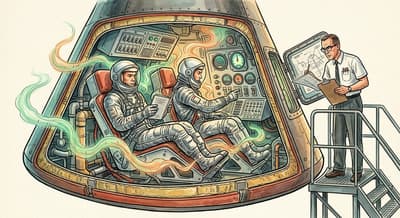
The bean detail matters because beans were basically nature’s stress test. Roach noted that during the peak period after a bean-heavy meal, a person can produce anywhere from one to almost three cups of gas per hour.[1] In your kitchen, that is embarrassing. In a tiny metal capsule packed with electronics, oxygen systems, and nowhere to “crack a window,” it starts to sound like an engineering problem.
And that is the larger point you might miss if you only laugh at the headline: early spaceflight forced scientists to rethink ordinary human life as a systems problem. Eating, sleeping, sweating, burping, and going to the bathroom all had to be studied because once you seal people inside a spacecraft, the body stops being background noise and becomes part of the machine.[2][3]
The unexpected twist is that NASA did not end up building a methane-free astronaut corps. According to NPR’s account, the practical solution was simpler: keep especially gas-producing foods such as beans, cabbage, sprouts, and broccoli off flight menus for a time.[1] Decades later, NASA’s food systems look very different. The agency now describes Artemis II menus as the product of long advances in nutrition, safety, packaging, and spacecraft design, a reminder that the problem was never just food. It was how to make humans livable in space.[3]
That is why this odd little episode matters. It is funny, yes, but it also reveals something real about exploration. Before you get moonshots and grand speeches, you get technicians asking whether lunch might accidentally ignite the cabin. Progress is rarely glamorous up close. Sometimes it is a room full of experts discussing beans, methane, and the future of mankind with straight faces. And honestly, that may be the most human part of the whole story.[1][2]