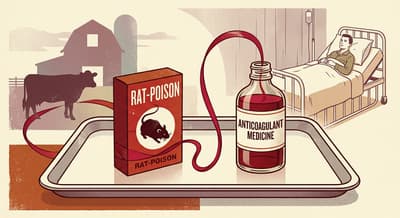
You probably do not expect one of medicine's most important drugs to start life as something scattered along baseboards for rats. But warfarin did exactly that, and the turn in its story came after a young Army inductee tried, and failed, to kill himself with the poison in 1951.[1]
That failure changed medicine. Doctors already knew warfarin was lethal to rodents because it triggered catastrophic internal bleeding. What they did not know was whether the same chemistry could be controlled in humans. When the recruit survived multiple doses and recovered after treatment with vitamin K, physicians suddenly had something priceless: proof that warfarin's effects could be reversed.[1][2]
The backstory is even stranger. Warfarin was born out of a farm mystery, not a hospital one. In the 1920s and 1930s, cattle across the northern plains kept bleeding to death after eating spoiled sweet clover hay. A Wisconsin farmer named Ed Carlson reportedly drove a dead cow and a can of its unclotted blood all the way to the University of Wisconsin, where biochemist Karl Paul Link and his team began chasing the cause.[1][2]
After years of work, the lab isolated dicoumarol, the anticoagulant produced when mold altered the plant chemicals in the hay. Then Link's group started making chemical cousins. Compound number 42 turned out to be especially good at causing fatal bleeding in rats. It was named warfarin, after the Wisconsin Alumni Research Foundation, and sold commercially as a rodenticide before doctors ever trusted it as a drug.[1][2]
The unexpected angle is that the failed poisoning was not just a dramatic anecdote. It solved the central fear. If vitamin K could reliably counteract warfarin, then a substance infamous for making pests bleed to death might actually be dosed, monitored, and used therapeutically in people vulnerable to dangerous clots.[1][2] That mattered because the earlier anticoagulants were clumsier. Heparin had to be injected, and dicoumarol was slower and less predictable.[2]
By 1954, warfarin had been approved for human use. A year later, President Dwight Eisenhower received it after his heart attack, which helped make the former rat poison look less like a toxic gamble and more like mainstream medicine.[2] Britannica still describes warfarin as a drug that interferes with vitamin K metabolism to reduce clotting, while noting that the same mechanism makes it dangerous enough to serve as a rodent poison in higher concentrations.[3]
Medicine is full of substances that seem monstrous until dose, context, and timing turn them into lifesaving tools. Warfarin is a reminder that the line between poison and cure is often thinner than you think, sometimes thin enough to fit inside a bottle pulled from under the kitchen sink.[1][2][3]