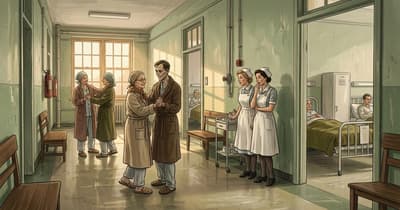
In 1952, the tuberculosis patients at Sea View Hospital gave doctors a problem the ward was not built to answer. Some got out of bed. Their appetites came back. They slept better. They became euphoric. A few danced in the hallways.[1] The drug was being tested against tuberculosis, but the behavior in the halls would become one of the early clues that medicine could change depression too.
The drug was iproniazid, a relative of isoniazid, tested in the hunt for better tuberculosis treatments. In January 1953, Edward Robitzek, Irving Selikoff, Evelyn Mamlok, and Alan Tendlau published the sort of paper a lung hospital expected: isoniazid and its isopropyl derivative in human tuberculosis therapy, with toxicology and comparative results.[3] The patients made the title feel too small.
The question had teeth. When a medicine for infection makes a person want food, sleep, company, and motion, what exactly has improved? Later reviewers used proper language for iproniazid's effects: euphoria, psychostimulation, increased appetite, improved sleep.[2] The list is accurate. It just sounds tidier than the thing doctors were seeing: sick people, treated for a lung disease, beginning to act as if some other part of life had been returned.
That is why the hallway mattered. Iproniazid was not developed as an antidepressant. It arrived as a tuberculosis treatment, then forced doctors to pay attention to changes that did not fit neatly inside a chest X-ray or a sputum test. The same movement could be dismissed as a strange side effect, written down as ward gossip, or followed as a clue. Modern antidepressant research grew in part because someone treated the clue as real.
Another medicine supplied the darker half of the puzzle. BrainFacts describes H.B., a 52-year-old retired policeman taking reserpine for blood pressure, who stopped enjoying gardening and television and woke early thinking about suicide.[1] In one account, a drug seemed to return appetite and motion. In the other, a drug seemed to remove desire from ordinary life. Mood, which can feel like the most private weather on earth, had left fingerprints on the prescription pad.
Iproniazid helped push researchers toward the monoamine hypothesis, which connected depression to chemical messengers such as serotonin, norepinephrine, and dopamine.[2] That theory would be revised, argued over, and complicated for decades. But Sea View gave psychiatry something less polished and more useful than a finished theory: patients changing in ways the original trial had not set out to find.
The origin story of modern antidepressants, then, does not begin only with a laboratory diagram. It also has a tuberculosis ward, a medical paper with four names on it, and patients who were expected to stay sick in bed crossing a hospital hallway instead.