
Most punishments in Greek mythology fit the crime in a neat, brutal way. Tantalus is tormented by food and water he can never reach. Ixion is bound to a burning wheel. Narcissus is trapped by his own reflection. Then there is Sisyphus, eternally pushing a boulder uphill only to watch it roll back down.
People usually remember the boulder and forget the part that matters: Sisyphus was not punished for simple arrogance, or even for wickedness in the abstract. He was punished because he kept doing the one thing mortals are not allowed to do. He cheated death. Then he did it again. And then, unbelievably, he did it a third time.[1]
The King Who Always Had One More Trick
Sisyphus was the king of Corinth, and in Greek myth that already tells you something. He is not remembered as noble, tragic, or doomed by fate. He is remembered as clever in a dangerous, slippery way. This was a man whose intelligence did not make him wise. It made him hard to catch.[1]
Ancient sources consistently treat him as a trickster and schemer. In one famous story, Zeus carried off Aegina, the daughter of the river god Asopus. Sisyphus saw it happen and agreed to reveal what he knew, but only in exchange for a spring for Corinth. Even here, the pattern is obvious. He does not merely know things. He monetizes them. He treats divine secrets like bargaining chips.[2]
That kind of mind does not accept the basic terms of human life. It certainly does not accept death quietly.
The First Escape: Don’t Bury Me Properly
When Sisyphus finally approached death, he set a trap in advance. He instructed his wife, Merope, not to perform the proper burial rites and not to place his body in the grave with the usual honors. This was not neglect. It was strategy.[1][3]
In Greek religion, burial mattered. The dead were supposed to be mourned, buried, and sent on correctly. To be left unburied was not a minor social slight. It was a disorder, a rupture between worlds. Sisyphus understood that if he arrived in the underworld appearing to have been wronged, he might be able to turn cosmic bureaucracy into an exit route.
And that is exactly what he did. Once in the underworld, he complained that his wife had failed in her duty. He persuaded Persephone, queen of the dead, to let him return temporarily to the world above so he could reprimand her and ensure the proper rites were carried out.[3]
It was a remarkably shameless lie. Sisyphus had personally arranged the offense he was pretending to protest.
The Second Escape: He Chained Death Itself
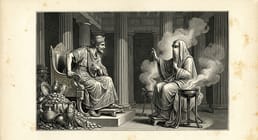
But even that was not his most outrageous trick. In another version of the myth, Zeus, already tired of Sisyphus’s behavior, sent Thanatos, the personification of death, to take him away. Sisyphus did what Sisyphus always did when confronted with a hard limit: he treated it like a puzzle.
He tricked Thanatos into demonstrating how the chains worked, then snapped the chains onto Death instead. Suddenly nobody could die. The world jammed. Battles still happened, wounds were still inflicted, but death itself had been taken off the board. The whole system stalled because one man had decided the rules were for other people.[1][2]
It took Ares, the god of war, to notice the absurdity. War without death is not war at all, just endless injury with no conclusion. So Ares intervened, freed Thanatos, and delivered Sisyphus to the fate he had postponed.[2]
This is the part of the myth that makes the punishment feel inevitable. Sisyphus does not merely fear death. He humiliates it. He treats mortality itself as something he can out-negotiate.
The Third Escape: The “Brief Return” That Wasn’t
Then came the final insult. Once Persephone allowed him that temporary trip back to earth to scold his wife for the missing burial rites, Sisyphus simply stayed there. He did not hurry to correct the ritual problem and nobly return below. He walked back into sunlight and kept living.[3]
That detail is what makes the story feel so modern. Sisyphus does not rebel in some grand philosophical sense. He exploits a loophole and runs. He behaves less like a tragic hero than like a man who has found a clerical error in the universe and intends to use it for all it is worth.
Eventually Hermes, the divine escort of souls, had to retrieve him by force.[3] At that point the gods were done negotiating.
Why the Boulder Makes Sense
His punishment is famous because it is visual, but it is really structural. Sisyphus spent his life wriggling out of finality. So he was given a task with effort but no completion, motion but no arrival, struggle but no payoff. The boulder rises, nearly reaches the top, then rolls back. Again. Again. Again.[1][2]
It is the perfect answer to his crime. Sisyphus wanted to escape the fixed boundary every human being must eventually accept. In return, the gods gave him a boundary he could never cross, no matter how many times he approached it.
That is why the myth has lasted. It is not just about punishment. It is about a very particular kind of person, the kind who mistakes cleverness for invincibility. Sisyphus is brilliant, resourceful, and impossible to contain right up until the universe decides to stop being impressed.
The boulder, in that sense, is not random torture. It is a verdict. You loved the game, the myth says. Fine. Here is a game you cannot win.
The Real Crime
If you strip away the poetry, Sisyphus’s offense becomes surprisingly clear. He staged his own burial grievance. He chained Death. He manipulated Persephone. He returned to earth on false pretenses and refused to go back. The crime that led to the boulder was not one bad act but a sustained campaign against mortality itself.[1][3]
And that may be why his story still lands. Greek myth is full of violence, vanity, and divine cruelty. But Sisyphus touches a more intimate nerve. Everyone wants one more day. Sisyphus wanted one more day, then another, then another after that. He just happened to be clever enough to keep pulling it off, until he wasn’t.
So yes, Sisyphus pushes the boulder because he was deceitful. Because he angered the gods. Because he acted like the smartest man in the room. But above all, he pushes it because he tried to do the one thing mythology reserves for disaster: he treated death as negotiable.
Sources
1. Encyclopaedia Britannica - Sisyphus
2. Pausanias, Description of Greece - references to Sisyphus