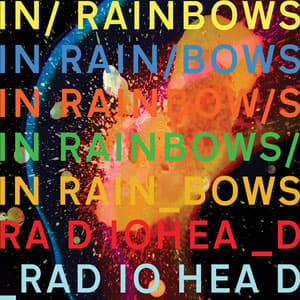
At 3:30 in the morning on 10 October 2007, the NPR contributor Jacob Ganz sat at his computer waiting for a download to begin [6]. Ten days earlier, Jonny Greenwood had announced Radiohead's seventh album in a 25-word blog post [5]. In Rainbows went live on the band's own website that day with no label and no fixed price, and buyers typed in whatever amount they wanted, including nothing [3][5].
Radiohead's recording contract with EMI had ended with Hail to the Thief in 2003, which left the band under no obligation to deliver a new record [3]. Writing and recording began in early 2005 at their studio in Oxfordshire [3]. Sessions with the producer Spike Stent proved fruitless, and in 2006 the band re-enlisted Nigel Godrich, their producer since 1994 [2][3]. They worked at Halswell House, Tottenham House, the Hospital Club in London and their own Oxfordshire studio [3].
Buyers on the download page entered a price and paid by credit card or PayPal, and a figure of zero still returned the files [10]. A separate diskbox edition, priced at £40 and shipped later, carried a bonus disc and artwork inserts [5]. Researchers describe this kind of arrangement as participative pricing, and note that it tends to work for products with low marginal cost, a fair-minded customer base and a strong existing relationship between buyer and seller [4].
Keith Green sold his 1980 album So You Wanna Go Back to Egypt by mail-order coupon for whatever the purchaser sent [4]. The Canadian songwriter Jane Siberry introduced self-determined pricing on her website in 2005 and told The Globe and Mail that her average income per song came out slightly above her standard price [4]. Jeff Rosenstock's Quote Unquote Records began offering free downloads with an optional donation the same year [4]. Radiohead's version drew international attention because no act of its size had tried it [3][7].
Within the first month, more than 1.2 million people downloaded the album, and one case analysis put the average payment at about $6 [8]. Radiohead's management hired Eric Garland of Big Champagne and the economist Will Page to study the paid sales and the illegal downloads together [6]. Thom Yorke told Wired that the band could attempt the release only because of years spent inside the conventional industry, adding: "It's not supposed to be a model for anything else. It was simply a response to a situation." [6]
XL Recordings handled the retail release internationally on 3 December 2007, and TBD Records followed in North America on 1 January 2008 [3]. The retail release reached number one on the UK Albums Chart and on the Billboard 200, and by October 2008 it had sold more than three million copies worldwide [3]. It was the best-selling vinyl record of 2008 and is certified platinum in the UK and Canada [3]. The single "Nude" reached the top 40 of the US Billboard Hot 100 [2].
EMI announced a Radiohead box set on 10 December 2007, days after the band signed to XL [1]. The set gathered the first six studio albums and the live record I Might Be Wrong across seven CDs, a USB stick and a download, and Radiohead had no input into it [1]. Commentators including the Guardian read the release as retaliation, and the band was reportedly incensed [1]. A Google advert for the set falsely claimed that In Rainbows was included; EMI blamed a data source glitch and removed it [1].
At the 51st Grammy Awards, In Rainbows won Best Alternative Music Album and Best Boxed or Special Limited Edition Package and was nominated for Album of the Year [3]. The arrangements, built around live playing and restrained processing after the electronic experiments of Kid A and Amnesiac, drew praise on their own terms [9]. Radiohead promoted the record with webcasts, music videos, competitions and a worldwide tour [3].