You expect the government to find you through taxes, school records, maybe a driver's license. You do not expect it to find you through a children's ice cream club.[1]
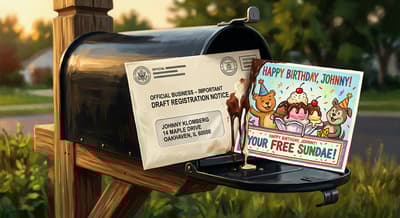
That was the unsettling part of the Johnny Klomberg story in 1984. Seven years earlier, two brothers in Palo Alto had filled out forms for Farrell's Ice Cream Parlor's birthday club using made-up names and their real address, hoping to score free treats.[1][2] One of those imaginary boys was Johnny Klomberg. Then, out of nowhere, a Selective Service notice arrived warning Johnny that he had 30 days from his upcoming 18th birthday to register for the draft.[1][2]
The detail that made the whole thing unforgettable was simple: Johnny Klomberg did not exist.[1][2] He was a prank, the kind of harmless scam kids invent because free ice cream feels like treasure and forms feel like loopholes. But the letter to a fictional teenager revealed something very real. The Selective Service had been buying commercial mailing lists to track down young men who might need draft-registration reminders.[1]
According to Snopes' reconstruction of the case, the agency paid a mailing-list broker $5,687 for 167,000 names from Farrell's birthday club in 1983.[1] UPI reported that officials were sending out about 3,500 notices a month tied to the Farrell's list.[2] In other words, this was not a one-off clerical blunder. It was a system.
And this is where the story stops feeling quaint and starts feeling modern. Long before anyone worried about apps listening to them or advertisers following them around the internet, there was already a thriving business in trading personal information. As The Saturday Evening Post notes, mailing-list brokers had been renting and reselling names for decades, turning everything from recipe-book requests to donor rolls into profit.[3] A list of names was never just a list of names. It was a product.
The unexpected angle is that the scandal was not really about the draft. It was about category confusion. Farrell's customers thought they were joining a birthday club. Farrell's thought it was running a promotion. A broker saw inventory. Then the government saw an enforcement tool.[1][3] Same data, four completely different meanings.
That is why the story still lands. Today, almost all men 18 to 25 living in the United States must register with Selective Service.[4] But Johnny Klomberg's phantom draft notice captured a deeper truth that now defines modern life: the moment you hand over information for one innocent reason, someone else may decide it is useful for another.[3]
Two kids tried to game an ice cream promotion and accidentally exposed the logic of the data economy years before most people had language for it. The free sundae never arrived. The lesson did.[1][2][3]