When the richest man in the ancient world asked the gods if he should go to war, the answer he got back was technically correct. It just wasn't what he thought it was.
Croesus, King of Lydia around 560 BCE, was so wealthy that his name still shows up in the phrase "rich as Croesus."[1] His kingdom, in what is now western Turkey, sat on rivers that ran with gold. He funded the construction of the Temple of Artemis at Ephesus, one of the Seven Wonders of the Ancient World. He was, by any measure, the kind of person who assumed the universe was on his side.
So when Persia began its rise under Cyrus the Great, Croesus didn't panic. He went shopping for divine permission.
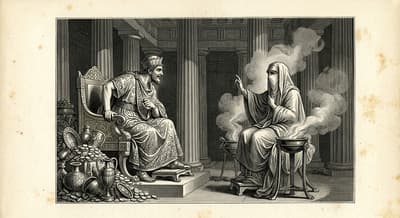
He sent emissaries to the Oracle at Delphi, the most respected prophetic institution in the Greek world, with lavish gifts: Herodotus catalogs them in detail, including 117 gold ingots, a solid gold lion, and mixing bowls of gold and silver.[2] His question was straightforward: if he marched against Persia, what would happen?
The Pythia, the priestess who delivered Apollo's pronouncements, gave him her answer: if Croesus attacked Persia, a great empire would be destroyed.[2]
Croesus heard exactly what he wanted to hear. He interpreted "great empire" as Persia. He mobilized his army and crossed the Halys River into Persian territory around 547 BCE.[3]
The campaign went badly from the start. After an inconclusive battle at Pteria in Cappadocia, Croesus retreated to his capital at Sardis for the winter, planning to rebuild his forces and resume in spring. He disbanded his army and sent messages to his allies, including Sparta, asking them to gather reinforcements.[2]
What Croesus did not anticipate was that Cyrus had no intention of waiting. The Persian king moved so fast that his army appeared at the walls of Sardis before the messengers had even reached Sparta.
Croesus scrambled his remaining cavalry and met Cyrus at the Battle of Thymbra, just outside the city gates. Cyrus, facing a cavalry force the Lydians prided themselves on, deployed a peculiar countermeasure: camels. Horses, apparently, cannot stand the smell of camels. The Lydian cavalry horses panicked and fled.[2] Cyrus drove the remnants of the Lydian army inside the walls and besieged the city for 14 days before it fell.[4]
Herodotus records that Croesus was captured alive, placed atop a great funeral pyre, and at the last moment spared by Cyrus, who was so moved by the fallen king's invocation of the Athenian sage Solon that he ordered the flames extinguished. Croesus spent his remaining years as an advisor at the Persian court.[2]
Later, according to Herodotus, Croesus sent back to Delphi to complain that the Oracle had misled him. The reply, as recorded, was perfectly maddening in its precision: the prophecy was accurate. A great empire had fallen. The Oracle had simply not specified whose.[2]
This is what made the Oracle so durable as an institution for nearly a thousand years: it was never technically wrong. The ambiguity wasn't a bug. It was the whole product.[5] Kings and generals came with their assumptions already formed, paid handsomely for language that could accommodate those assumptions, and then went home to make their choices. The Oracle gave them permission slips that came with no refund policy.[6]
Croesus had every advantage: money, alliances, a massive cavalry, and what he believed was divine sanction. He still lost. Not because the Oracle deceived him, but because he heard the answer he'd already decided on before he asked the question.
That particular mistake hasn't gone out of style.
Sources
- Croesus — World History Encyclopedia
- Histories, Book 1.46–91 (Croesus and the Oracles) — Herodotus, Perseus Digital Library
- Croesus, King of Lydia — Encyclopædia Britannica
- Siege of Sardis (547 BC) — Wikipedia
- Croesus and the Oracles — Journal of Hellenic Studies, Cambridge University Press
- The Delphic Oracle: Its Responses and Operations — Joseph Fontenrose, University of California Press