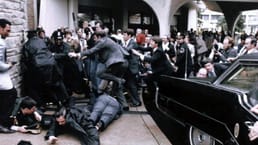
On March 30, 1981, John Hinckley Jr. fired six bullets in 1.7 seconds at President Ronald Reagan as he left the Washington Hilton Hotel in Washington, D.C., after a speaking engagement [1][2]. Jerry Parr, then head of the White House detail, shoved Reagan into the presidential limousine before the shooting stopped [2].
The push knocked Reagan out of the line of fire, and one round passed over him that would otherwise have struck his head [2]. The final bullet ricocheted off the armored side of the limousine and entered Reagan's left underarm, breaking a rib, puncturing a lung and stopping less than an inch from his heart [1][2]. Reagan later said he thought the rib had cracked when Parr pushed him into the car [2].
Parr's first radio call reported that "Rawhide is OK" and announced a return to the White House, whose medical facilities he preferred to those of an unsecured hospital [2]. He changed course and diverted the motorcade to George Washington University Hospital, where Reagan underwent emergency exploratory surgery and was released on April 11 [1][2]. Three other men were wounded in the attack: press secretary James Brady, Secret Service agent Tim McCarthy and D.C. police officer Thomas Delahanty [1].
Jerry Studstill Parr was born in Montgomery, Alabama, on September 16, 1930, and grew up in the Miami area [2]. He earned a B.A. in English and philosophy from Vanderbilt University in 1962, and in 1987 an M.S. in pastoral counseling from Loyola University in Maryland [2]. An ordained minister, he received an honorary doctorate in humane letters from Eureka College in 1987 [2].
As a boy, Parr watched Code of the Secret Service, a 1939 film directed by Noel M. Smith in which Reagan played Secret Service Lieutenant Brass Bancroft [2][3]. It was the second of four Brass Bancroft pictures Warner Bros. produced as part of a studio effort to portray law enforcement favorably [3]. Reagan called it "the worst picture I ever made," and a ticket taker in one city told him he should be ashamed [3].
In 1962 Parr was working as a lineman for Florida Power and Light when a visiting Secret Service recruiter interviewed him [2]. Asked whether he could accept the risks of the job, Parr replied that it was probably no more dangerous than what he had been doing for the power company [2]. He joined at 32 as the oldest rookie in his class, and his first protection assignment was John F. Kennedy and Lyndon B. Johnson at the funeral of Eleanor Roosevelt [2].
After Kennedy was assassinated, Parr was assigned to protect Marina Oswald and Marguerite Oswald until Marina completed her testimony before the Warren Commission [2]. Over 23 years he conducted 15 foreign and 65 domestic protective surveys and worked in all 50 states and 37 countries [2]. From 1969 to 1978 he directed security for 56 foreign heads of state, among them Queen Elizabeth II, Emperor Hirohito, King Juan Carlos of Spain and Pope John Paul II [2].
Parr took charge of the Presidential Protective Division in 1979, directing security for Jimmy Carter and then for Reagan [2]. He became assistant director of protective research in 1982 and retired from the Secret Service in 1985 [2]. His wife Carolyn, who was standing across the street when the shooting began, co-wrote his autobiography, In the Secret Service [2]. Parr died on October 9, 2015 [2].