Administrative names are usually designed to be boring. They are supposed to sound bureaucratic. They are supposed to disappear into maps.
Greenland did something better.
If you directly translate the names of its five municipalities from Greenlandic into English, you do not get the clipped official language most governments prefer. You get something far more vivid: “Much Ice,” “South,” “Centre,” “The One With Islands,” and “Northern.”[1]
That sounds less like a spreadsheet and more like a place describing itself honestly.
When A Map Stops Pretending To Be Abstract
There is a reason these names feel so striking in English. Most political boundaries are named after people, old kingdoms, tribes, saints, rivers, or historical accidents. Over time, the meanings blur. The words remain, but the image behind them fades.
Greenland’s municipal names do not really allow that. They stay close to geography. Close to orientation. Close to what the land looks like and how people move through it. Instead of trying to sound grand, they sound useful. Almost physical.
Kujalleq means “South.” Qeqqata means “Centre.” Avannaata means “Northern.” Qeqertalik means, roughly, “the one with islands.” And Kommuneqarfik Sermersooq is the long one, commonly rendered as “the place of much ice” or “municipality of much ice.”[1]
That last one, in particular, does not bother with subtlety. Greenland is a place where ice is not scenery. It is structure. Of course one of its municipalities might simply be called “Much Ice.” Anything more elaborate would almost feel dishonest.
These Names Sound Simple Because The Landscape Is Not
What makes the translations delightful is their bluntness. What makes them meaningful is Greenland itself.
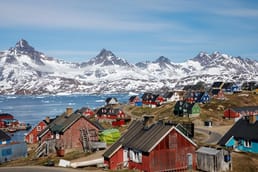
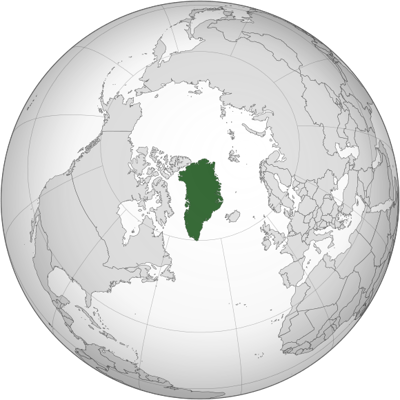
Greenland is the world’s largest island, and most of it is covered by ice. Its settlements cling mainly to the coast, separated by fjords, mountains, sea, and enormous distances.[1] This is not a landscape that encourages decorative naming. It encourages practical naming. If a place is south, that matters. If it is central, that matters. If it is full of islands, that definitely matters.
These are names shaped by orientation in a vast environment. They tell you less about political ideology than about how to think spatially in a place where space is the central fact.
That is the deeper charm here. At first glance, “South” or “Centre” can seem almost comically plain. But in a land as vast and difficult as Greenland, plainness is not laziness. Plainness is information.
“The One With Islands” Is Better Than Most Official Names
Qeqertalik may be the best of the set, because it sounds almost casual in English, like someone pointing at a map and saying, yes, that one, the one with islands.[1]
And yet that casualness is exactly why it works. Greenland’s western coast is deeply broken up, full of inlets, skerries, offshore landforms, and complex coastlines. “The One With Islands” is not poetic decoration. It is a direct relationship between language and terrain.
Many governments spend centuries trapped inside names that no longer tell anyone anything useful. Greenland’s municipal naming, by contrast, still feels legible. You can almost reconstruct the governing logic just by looking at the translations. One area is south. One is central. One is northern. One is especially icy. One is the island-rich one.
It is refreshingly unpretentious. It also happens to be memorable.
A Language That Keeps Place Close To Meaning
Part of what makes this so satisfying is that Greenlandic, or Kalaallisut, often preserves a strong sense of literal composition in place names that gets flattened in English-language maps.[1] English speakers are used to inherited names whose meanings are buried. Greenlandic names often feel more transparent once translated, as if the language were still in active contact with the landscape rather than merely labeling it.
That does not mean the names are simplistic. It means they are alive in use. They still point.
And once you notice that, the translations stop sounding funny and start sounding intelligent. “Much Ice” is not childish. It is efficient. “Centre” is not dull. It is orienting. “Northern” is not generic. In Greenland, north is not an abstraction. It is a condition.
The Bureaucracy Is Real, But So Is The Poetry
To be clear, these are real municipalities in a modern autonomous territory within the Kingdom of Denmark, not folkloric regions from some old map.[1] Greenland has contemporary administrative divisions, budgets, councils, elections, and all the usual machinery of government. But the names of those divisions still carry the landscape inside them.
That is what gives the whole thing its peculiar beauty. Modern administration usually strips language of texture. Greenland’s municipal names do the opposite. They make bureaucracy sound like topography.
Even Kommuneqarfik Sermersooq, the most institutional-sounding of the five, becomes memorable the moment you learn what it means. Not an honorific. Not a founder’s surname. Not a vague patriotic flourish. Just ice, and a great deal of it.
Why People Love This Fact
This fact travels well because it contains a small shock of clarity. It reminds you that maps are written by someone, in some language, from within some relationship to the land. What sounds exotic in one language can turn out to be startlingly practical in another.
And it flatters a certain fantasy many people have about naming: that names should say what things actually are. What if governments stopped dressing places up in ceremonial language and just told the truth? Greenland, in this one narrow and wonderful way, seems to have done exactly that.
So yes, if you translate them directly, Greenland’s five municipalities come out as “Much Ice,” “South,” “Centre,” “The One With Islands,” and “Northern.”[1] It sounds amusing at first. Then elegant. Then it starts to feel like the kind of naming every map should have tried.