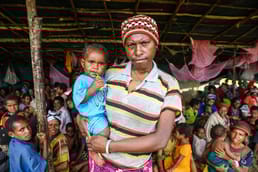
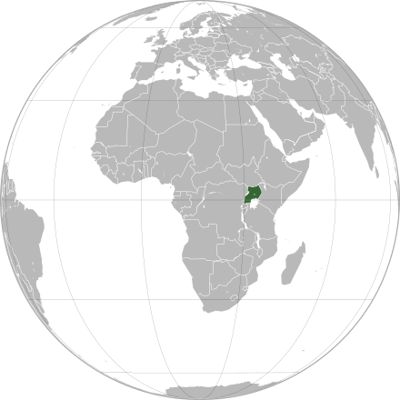
Imagine a country where childhood is not a stage of life at the margins, but the central fact of the nation itself. In Uganda, around 21 million people, roughly half the population, are under the age of 15. That is not a demographic footnote. It is the shape of the country.[1]
It changes the sound of a city street. It changes what classrooms, clinics, and labor markets must carry. It changes the meaning of the future, because in Uganda the future is not approaching slowly. It is already here, loud and crowded and waiting for a place to sit down.
A Nation With a Very Young Center
Uganda had a population of 45.9 million at the 2024 census.[1] That alone makes it one of Africa's major population centers. But the more startling number is the age structure. About half of Ugandans are still children. In many countries, people talk about aging populations, shrinking schools, and a growing share of retirees. Uganda sits at the opposite end of that spectrum. It is a country organized around youth.
And that matters, because age is not just a statistic. It is a national pressure point. A population this young means extraordinary demand for schools, teachers, vaccinations, maternal care, food systems, jobs, housing, and infrastructure. It also means a huge reservoir of energy, ambition, and human potential, if those systems can keep up.
Why Uganda Looks This Way
Part of the answer is simple arithmetic. Uganda has had high fertility for decades, and it has also made health gains that allow more children to survive into adulthood.[1] That combination creates what demographers call a youthful population structure, a society in which the base of the age pyramid is exceptionally wide.
But the story is also historical. Uganda is a country of 20th-century upheaval and 21st-century growth. It emerged from colonial rule in 1962, endured dictatorship, war, and political repression, and also made measurable progress in education, literacy, and health.[1] That progress does not erase the country's problems. It does, however, help explain why Uganda today is both under pressure and full of possibility.
The Burden and the Opportunity
A country with so many children faces an obvious challenge. Young people do not remain young for long. The 10-year-olds become 20-year-olds. The schoolchildren become job-seekers. The burden on primary schools turns into a burden on universities, training systems, and labor markets.
This is where Uganda's demographic story becomes more than surprising and starts becoming consequential. A very young population can become what economists call a demographic dividend, a period in which a large working-age generation helps drive growth. But that only happens if the right groundwork is in place: education that actually educates, healthcare that reaches people early, and an economy capable of absorbing millions of young adults.[1]
If those systems fail, the same youth bulge that looks like promise can turn into strain. The number itself does not decide the outcome. Policy does.
Kampala and the Pull of the Future
Uganda's capital, Kampala, is home to about 1.8 million people, but its influence stretches far beyond that number.[1] Like many capitals in fast-growing countries, it acts as a magnet, pulling in ambition from across the nation. A country this young does not stay still. It moves toward schools, cities, jobs, transport links, and possibility.
That movement puts pressure on urban life. More families need housing. More children need classrooms. More adolescents need a path from education into work. Uganda's demographic reality is not just visible in national census tables. It is written into traffic, construction, clinic queues, and crowded schoolyards.
A Country Larger Than the Stereotypes
It is easy for outsiders to reduce Uganda to a handful of familiar frames: an equatorial climate, Lake Victoria, the Nile basin, wildlife, or the long rule of Yoweri Museveni.[1] Those things are real. But the statistic in the title forces a different view. Uganda is not only a place on a map or a political story. It is one of the youngest large countries on Earth.
That youth helps explain why so many of Uganda's biggest questions are really about capacity. Can the education system scale? Can health gains continue? Can economic growth outpace the needs of a rapidly expanding generation? Can institutions keep up with the people moving through them?
When half a nation is under 15, the stakes of those questions become enormous.
The Human Meaning of 21 Million
Big numbers have a way of becoming abstract. Twenty-one million can sound like a spreadsheet entry. But it means millions of children not yet old enough to vote, drive, or earn a living, who will nevertheless shape everything about the country's next two decades. It means enormous dependency today, followed by enormous pressure tomorrow.
It also means something hopeful. Uganda's youth is not just a challenge to be managed. It is a vast inventory of unrealized lives. Every country talks about investing in the future. Uganda, in a very literal way, is surrounded by it.
That is what makes this fact so striking. It is not merely that Uganda is young. It is that youth there is not a minority condition. It is the country's dominant reality.