In 1848, people rushed to California dreaming of gold. They arrived with pans, wagons, shovels, rifles, and the familiar mythology of the American frontier, that old story in which land is simply there, waiting for energetic newcomers to claim it. What disappears inside that story is the fact that California was not empty. It was densely inhabited by Native peoples speaking dozens of languages and living in hundreds of distinct communities, with social worlds that had developed over thousands of years.[1]
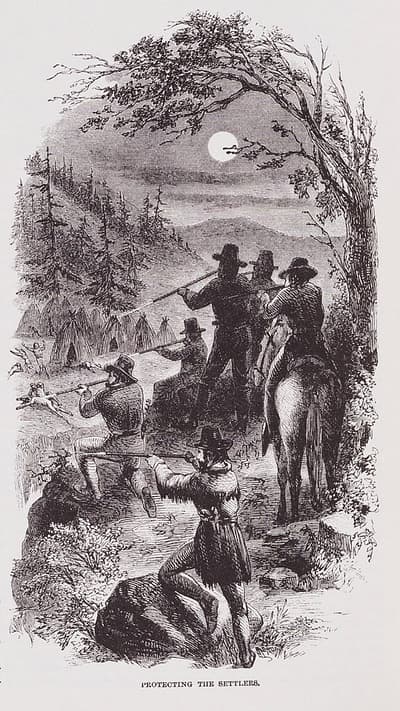
And then, within the span of a single generation, that world was shattered. California’s Native population, estimated at as many as 150,000 in 1848, fell to around 30,000 by 1870.[1] Some died from disease and starvation. Many were driven from their homelands. Thousands were murdered. Women and children were kidnapped. Indigenous labor was coerced. State authorities funded militia campaigns. The violence was not random chaos at the margins of settlement. To a disturbing degree, it was organized, tolerated, and at times openly supported.[1]
This is what historians mean when they speak of the California genocide. And part of what makes it so easy to miss in American memory is that it unfolded at the exact moment the country prefers to remember California as a place of glittering possibility. The Gold Rush became legend. The killing that accompanied it became a footnote.
California Before the Rush
Before the United States seized California from Mexico, Native California was extraordinarily diverse. The region contained one of the densest concentrations of Indigenous cultures north of Mexico, with communities adapted to coasts, valleys, mountains, forests, and river systems.[1] That matters, because what followed was not the destruction of one people, but of many. The phrase “California Indians” can flatten the story if you let it. In reality, what was shattered was a mosaic.
That mosaic had already been damaged by the Spanish mission system and later by Mexican rule. Disease, forced labor, displacement, and cultural disruption had been at work long before 1848.[1] But the American conquest of California, followed immediately by the Gold Rush, produced destruction on a different scale and at a different speed. It brought vast numbers of settlers, armed men, speculators, and state institutions all at once. Pressure became invasion. Prejudice became policy.
When Gold Turned Human Beings Into Obstacles
The Gold Rush is often told as a story of ambition. Men heard about gold in the Sierra foothills and surged westward in hopes of sudden transformation. But rushes of wealth have a way of turning the people already there into inconveniences. Native communities stood in the path of mining claims, ranching expansion, town building, transport routes, and a ravenous hunger for land.
And so the logic shifted with terrifying speed. Indigenous people were no longer seen merely as poor, backward, or unfortunate. They were increasingly treated as obstacles to be removed.[1] That removal took many forms. American colonists murdered Native Californians in massacres and raids. Enslavement, rape, child separation, kidnapping, and forced displacement became widespread. The violence was encouraged, carried out, and tolerated by state authorities and militias.[1]
Between 1849 and 1870, it is conservatively estimated that American settlers killed about 9,500 California Natives outright.[1] “Conservatively” is the crucial word there. It suggests not precision, but a floor. The real number may well have been higher.
The State Helped Pay for It
One of the most unsettling aspects of the California genocide is that it was not simply a matter of lawless frontier brutality. The state itself was implicated. California’s government funded militia expeditions against Native communities and then sought reimbursement from the federal government.[1] In other words, the violence was not merely permitted. It was budgeted.
This is the point where the story stops looking like spontaneous racial hatred, though it certainly included that, and starts looking like something colder. Administrative. Procedural. The machinery of a new state was helping finance campaigns that destroyed the people already living within its borders.
And that matters because it changes the moral shape of the story. It is easier, psychologically, to blame atrocity on mobs. It is harder to admit what it means when governments help organize the conditions for mass death.
Violence, Hunger, and the Destruction of a World
Genocide is rarely a single mechanism. It is usually a stack of them. Direct killing was one layer. Starvation was another. Native people were driven off hunting grounds, fisheries, villages, and food sources. Communities already weakened by epidemics and social disruption were pushed into even more precarious conditions.[1]
Women and children were especially exposed. The system of unfree Indigenous labor in California trapped many Native people in conditions resembling slavery, while kidnappings and family separations tore communities apart.[1] What disappears inside population figures is the intimacy of that destruction. A society does not die only in massacres. It dies when its children are taken, when its women are terrorized, when people can no longer remain on their land, when language communities are broken apart, when memory loses the places that anchor it.
That is part of why the collapse from roughly 150,000 to 30,000 matters so much.[1] It is not just a demographic drop. It is a measure of how quickly a human landscape can be made to vanish.
The Yahi and the Logic of Erasure
Among the most haunting examples are the Yahi, a branch of the Yana people, who were hunted to extinction in northern California.[1] Even now, that phrase lands with unusual force: hunted to extinction. It sounds zoological, as if the subject were animals. In a way, that is the point. Settler violence often depends on first demoting its targets from neighbors or nations into creatures, nuisances, threats, or beings outside moral concern.
The Yahi story is remembered in part because one survivor, known to history as Ishi, emerged in the early twentieth century after years of hiding following the destruction of his people.[1] His appearance became famous. But fame can be its own disguise. People remember the “last wild Indian” myth that grew around Ishi more readily than they remember the process that made such a figure possible in the first place. A person becomes “the last” only after an entire world has been destroyed.
Why So Many People Never Learned This
The California genocide remains strangely absent from popular American memory for a simple reason: it competes with a brighter story. The Gold Rush is cinematic. It offers greed, grit, reinvention, instant fortune, wagons heading west, and a new state rising almost overnight. It fits neatly into the American habit of turning expansion into adventure.
Genocide interrupts that narrative. It forces a different reading of the same event. The miners are no longer merely dreamers. The frontier is no longer merely opportunity. The making of California begins to look less like romance and more like dispossession on a colossal scale.
And so the story gets softened. Schoolchildren may hear that disease reduced Native populations, which is true, but incomplete. They may hear there were “conflicts” with Native tribes, which is technically accurate in the way euphemism is accurate. What they are less often told is that many contemporaries openly called for extermination, that militias were publicly funded, that Native children were abducted, that rape and enslavement were widespread, and that the destruction was severe enough for historians to use the word genocide.[1]
The Harder Meaning of California
To confront the California genocide is to confront a larger truth about the United States. Expansion was not only a story of building. It was also a story of clearing. New beginnings for some people often depended on ending the world of others.
This does not mean the Gold Rush was only one thing. History is never that neat. It means its celebratory version is radically incomplete. Gold brought fortune seekers west. It also accelerated the destruction of Native California. Both things are true at once, and the second helps explain the human cost of the first.
That is why this history matters now. Not because it adds a darker footnote to a familiar story, but because it changes the story itself. California did not simply emerge out of ambition and luck. It was also made through organized violence, tolerated terror, and the catastrophic collapse of the peoples who were already there.
And once you see that, the old image of the Gold Rush, all glitter and possibility, becomes much harder to look at in quite the same way again.