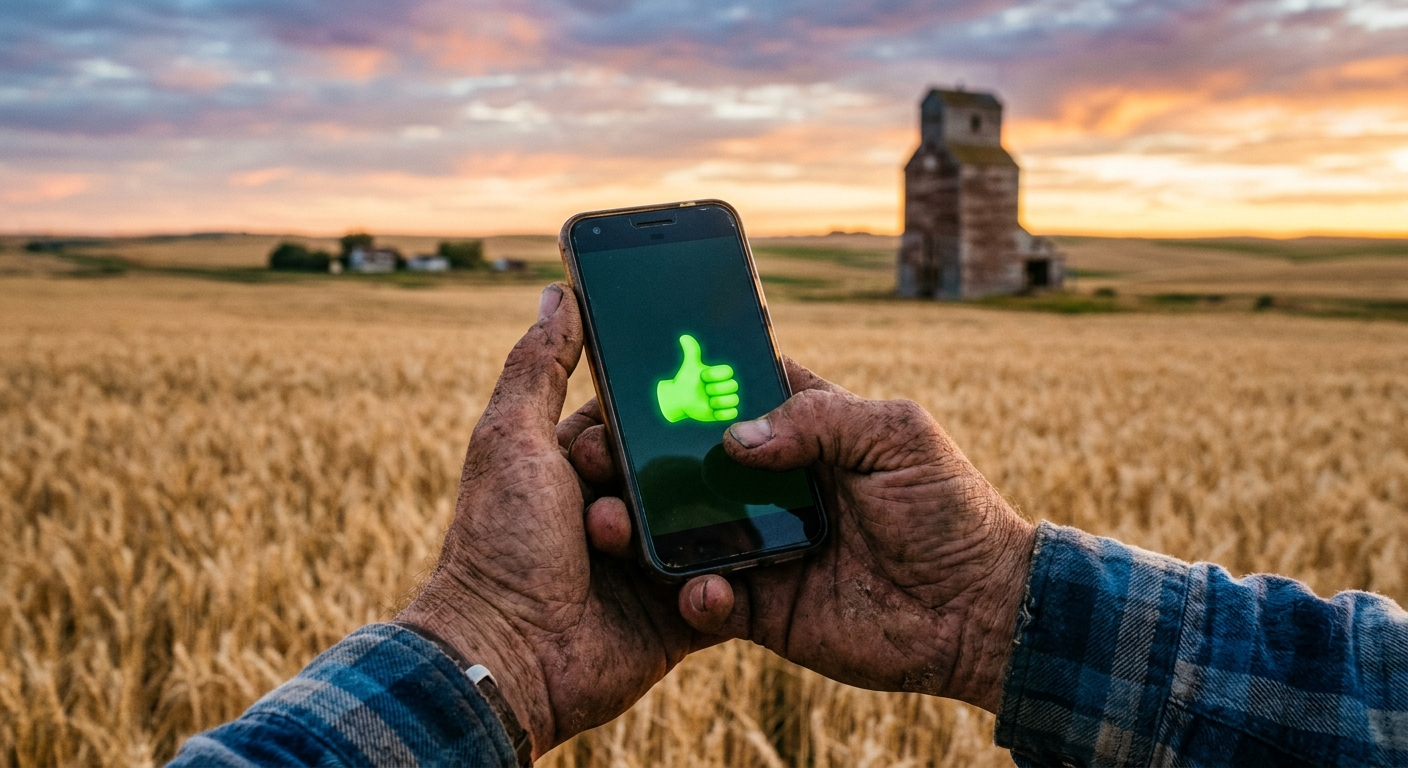
Chris Achter just wanted the guy to stop texting him. A Saskatchewan farmer with dirt under his nails and grain to manage, Achter had been doing business with South West Terminal — a local grain company — for years. The routine was simple: they'd agree on a price over the phone, the buyer would text over a photo of the contract, and Achter would fire back something like "yup" or "looks good." Done. Handshake by text message.[1]
So in March 2021, when SWT's rep Kent Mickleborough texted a photo of a signed contract for 87 metric tonnes of flax at $17 per bushel with the message "please confirm flax contract," Achter did what came naturally. He sent a thumbs-up emoji. 👍
That single tap of his thumb would cost him $82,200.
The Emoji Heard 'Round the Prairies
When November came and flax prices had climbed, Achter never delivered the grain. South West Terminal sued. And the question that landed on Justice Timothy Keene's desk in Saskatchewan's Court of King's Bench was one no Canadian judge had faced before: does a 👍 constitute a legally binding signature?[2]
Achter's defence was straightforward. He said the emoji was his way of saying "I got your text" — an acknowledgment of receipt, not agreement to terms. His lawyer warned that ruling otherwise would "open the flood gates" to courts having to interpret the fist bump, the handshake emoji, the winking face. Where would it end?
Justice Keene wasn't buying it. He looked at the history: fifteen to twenty prior contracts, all confirmed through the same text-message-and-casual-reply pattern. The "yup" contracts were binding. The "looks good" contracts were binding. A reasonable person watching this exchange, the judge reasoned, would see no meaningful difference between those words and 👍.[1]
"This court readily acknowledges that a thumbs-up emoji is a non-traditional means to 'sign' a document," Justice Keene wrote, "but nevertheless under these circumstances this was a valid way to convey the two purposes of a 'signature.'"[2]
All the Way to the Top
Achter appealed. In 2024, the Saskatchewan Court of Appeal upheld the decision 2-1, with the majority offering a quietly elegant observation: courts have always interpreted subtle human communication — nods, handshakes, gestures. An emoji is just "a modern twist to this otherwise rather unremarkable observation."[3]
The dissenting judge, Justice Barrington-Foote, went even further in one respect — suggesting courts could "take judicial notice" that a thumbs-up emoji can signify approval. In other words, everyone already knows what it means.[4]
In July 2025, the Supreme Court of Canada declined to hear a further appeal, letting the ruling stand as settled law.[4] A single emoji, sent in three seconds on a dusty Saskatchewan afternoon, had survived three levels of judicial scrutiny.
You're Not the Only One Sweating
The Achter case didn't arrive in a vacuum. In 2017, an Israeli small claims court ruled that a string of cheerful emojis — including a smiley face, a champagne bottle, and a dancing figure — sent by prospective tenants to a landlord signaled enough positive intent to justify damages when the deal fell through. That case, Dahan v. Shakaroff, cost the texters about $2,200.[5]
In the United States, emoji evidence has appeared in cases ranging from contract disputes to sexual harassment claims to criminal threats. A Florida appeals court examined whether a gun emoji, sent in context, constituted a credible threat.[6] The Fordham Law Review has even proposed a formal framework — "The Federal Rules of Emojis" — for handling emoji evidence at trial.[7]
Legal scholar Eric Goldman, who tracks emoji court cases, notes the critical insight: emoji interpretation isn't really a new skill for judges. "All of the techniques courts routinely use to interpret human communication are likely to work with emojis as well," he writes. The real trap isn't that emojis are exotic — it's that people treat them as throwaway, when courts increasingly treat them as evidence.[3]
Why This Matters to You
Here's the thing about the Achter ruling that should make you pause next time your thumb hovers over that little yellow icon: the court didn't say a thumbs-up emoji always means "I agree." It said that in context — given the relationship, the history, the pattern of communication — a reasonable person would understand it that way.
Which means the meaning of your emoji depends on who you're texting, what you've texted before, and what a judge thinks a "reasonable bystander" would conclude. Your casual 👍 to your friend about dinner plans probably won't land you in court. But that 👍 to your contractor about a renovation quote? To your business partner about a deal? You might want to type out the words instead.
As Justice Keene put it: the court "cannot and should not attempt to stem the tide of technology and common usage." The law is watching your texts. It just learned to read emoji.
Sources
- Canadian Court Elevates Thumbs-Up Emoji to Signature Status — McCabes Lawyers
- TIL Thumbs Up Emoji Contract Case — r/todayilearned
- Thumbs-Up Emoji Formed Binding Sales Contract — Eric Goldman's Technology & Marketing Law Blog
- When Does 👍 Mean Yes? Supreme Court of Canada Lets Emoji Contract Case Stand — Lawson Lundell
- The Israeli Chipmunk Emoji Mystery Resolved — Eric Goldman's Technology & Marketing Law Blog
- Florida Appeals Court Hears Gun Emoji Criminal Case — Tampa Criminal Lawyer Blog
- The Federal Rules of Emojis — Fordham Law Review