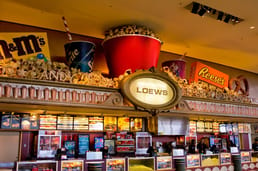

A medium popcorn at a U.S. movie theater averaged $8.14 in 2023, according to EntTelligence data reported by CNBC and cited by Money Digest [3]. That is the visible end of a transaction most moviegoers know: a bag of popcorn and a price that seems out of proportion to the ingredients. The ingredients are cheap. The business around them is not.
Reader's Digest put the popcorn markup at 1,275 percent, using an example of a bag that costs 37 cents to make and can sell for $5 [1][4]. The figure describes the gap between cost and selling price, not the theater's profit. A 1,275 percent markup means the selling price is 1,375 percent of the cost, or 13.75 times what the theater paid [2]. At that rate, a large bag selling for $7.50 would cost the theater about 55 cents [2]. The arithmetic is simple. The reason theaters rely on it is less so.
Concessions matter because the theater keeps that money. Money Digest reports that 100 percent of concession sales go directly to the theater, unlike ticket sales [3]. The profit margin on concessions is usually more than 80 percent [3]. For AMC, concessions account for 36 percent of total revenues; for Cinemark, 39 percent [3]. A popcorn sale is not a side transaction. It is central to the economics of the building.
That dependence has grown as attendance has struggled. In January 2024, movie attendance was down 33 percent compared with January 2019, according to Advan Research data cited by Money Digest [3]. The 2023 domestic box office reached $8.9 billion, a 20.9 percent increase over 2022 but still below the 2018 peak [3]. Part of the gap comes from fewer releases: 993 in 2018 versus 592 in 2023 [3]. Fewer tickets mean fewer chances to sell snacks, which makes each concession sale more valuable.
Theaters have responded by widening the menu. Money Digest notes that food and beverage profitability has driven expansion into cocktails and full meal options [3]. Rolando Rodriguez, chairman of the National Association of Theatre Owners, told CNBC that "The American consumer now is really demanding more than just a popcorn and a drink or nachos or candy" [3]. The concession stand is becoming a restaurant, and the popcorn markup helps pay for that bet.
The markup also has a consumer side. Reader's Digest reported that a Michigan man found the price so outrageous that he was suing his local theater [1][4]. The anecdote sits beside the larger numbers: a $5 bag in the Reader's Digest example, an $8.14 average medium popcorn in 2023 [1][3][4]. The sticker price is not imaginary.
Popcorn is not even the highest markup at the stand. Money Digest notes that bottled water is often marked up over 4,000 percent [3]. Reader's Digest puts a $2 bottle at about 5 cents to make [1][4]. That comparison helps explain why the concession case matters. The popcorn is cheap to make and sells at a price that helps support the theater. The water is another high-markup item in the same case.
The 1,275 percent figure is a cost-based markup, so it scales with the price. A $5 bag and a $7.50 bag can both carry a 1,275 percent markup if their costs are about 36 cents and 55 cents [1][2][4]. The percentage stays the same; the dollars change. That is why the average medium popcorn price matters to a theater's revenue as much as the percentage does [3].