
On a modern mall shelf, a movie can sit there without a projector: a T-shirt, a poster, a toy lightsaber, a little plastic hero waiting in a blister pack. That feels ordinary now. Before the 1970s, IndieWire notes, the market for Hollywood T-shirts, toys, games, and similar film merchandise was “virtually non-existent.”[3]
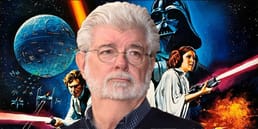
George Lucas’s reported $500,000 salary trade on Star Wars became one of Hollywood’s most famous business gambles: he kept merchandising rights, and by 2012 the first six films had generated about $20 billion in merchandising revenue.
There had been hints before Lucas. In 1929, Walt Disney licensed Mickey Mouse to an entrepreneur who paid $300 to put the character on a writing tablet.[3] It was a clever use of a cartoon face, but it did not yet describe a movie economy. For decades, film studios mainly sold tickets. The toys, shirts, lunchboxes, and bedsheets were secondary, if they existed at all.
Then came Star Wars in 1977, the original work in a franchise created by George Lucas that quickly became a worldwide pop-culture phenomenon.[1] The film gave audiences spaceships, droids, helmets, robes, laser swords, and a villain whose silhouette could be recognized from across a room. It also gave stores something unusually powerful: objects that children could hold after the credits ended.
The famous business turn was Lucas’s decision to accept a $500,000 cut to his director’s salary in exchange for full ownership of the franchise’s merchandising rights. At the time, that kind of side market did not look like the center of the empire. Movie merchandise was still widely treated as passive income, a bonus attached to the real product on screen.[3]
The real product kept multiplying. Star Wars expanded from the 1977 film into later films, television series, video games, novels, comic books, theme park attractions, and themed areas, forming what Wikipedia describes as an all-encompassing fictional universe.[1] Each expansion created more surfaces for the brand to live on: costumes, LEGO sets, action figures, lightsabers, collectibles, and even R2-D2-shaped toasters.[2][5]
The numbers eventually became difficult to compare with ordinary box office success. A list of highest-grossing media franchises estimates Star Wars at $46.7 billion in total revenue, including about $29.057 billion in merchandise sales, compared with about $10.343 billion at the box office.[4] Market Realist describes the franchise as holding the Guinness World Record for the most successful film franchise in merchandising, with a typical year bringing in roughly $5 billion to $7 billion from merchandise sales alone.[2]
That gap is the strange part. The movie was the spark, but the long money came from the things that followed people home. A ticket is used once. A plastic lightsaber can be swung in a backyard for years, passed to a sibling, replaced by a newer one, then bought again by an adult who remembers the first.
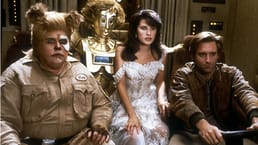
Even parody understood the scale. Spaceballs, Mel Brooks’s official Star Wars parody, was not allowed to release Spaceballs merchandise, according to Our Culture Mag. Brooks responded by making the absence of merchandise part of the joke, devoting an entire scene to mocking the endless stream of Star Wars products.[5]
Lucas’s half-million-dollar salary cut now reads less like a footnote than a hinge. Somewhere between the theater seat and the toy aisle, Hollywood learned that a story could keep earning long after the lights came up, one lunchbox, action figure, and glowing plastic saber at a time.