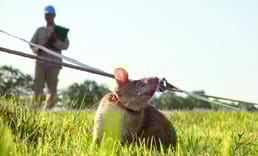
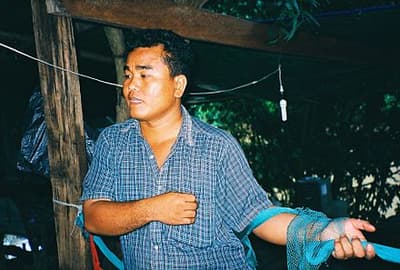
Imagine a field of tall grass. To a casual observer, it is a peaceful stretch of Cambodian countryside. But for someone who knows what to look for, that field isn't a landscape; it's a minefield. Every step is a gamble. Every footfall could be the last. For most, this is a nightmare scenario. For Aki Ra, it became a way of life.
It is a strange, almost paradoxical kind of heroism. A man once trained to plant the very devices that tear lives apart is now the man tasked with finding them. He isn't just hunting explosives; he is attempting to undo the damage of a history that tried to break him.
The Child Soldier's Burden
To understand Aki Ra’s mission, one must understand his beginning. His childhood was not defined by schoolbooks or playgrounds, but by the chaos of the Khmer Rouge regime. While his exact birth year remains uncertain—he estimates he was born around 1970 or 1973—the trauma of his early years is unmistakable[1].
The Khmer Rouge didn't just destabilize Cambodia; they dismantled the concept of family. For Aki Ra, the loss was absolute: his parents were killed by the regime[1]. Orphaned in a Khmer Rouge camp, he was taken in by a woman named Yourn, who cared for him and a group of other children caught in the crossfire of a revolution[1]. But in a regime built on indoctrination, survival often comes at a steep price. Like so many children caught in the gears of the conflict, Aki Ra was conscripted. He became a child soldier—a small figure trained to participate in a war that had no place for innocence.
He became a cog in a machine designed for destruction. He learned the mechanics of war, the placement of ordnance, and the lethal logic of the landmine. But when the regime fell, the war didn't end for the people of Cambodia; it simply moved from the battlefield into the soil.
Fifty Thousand Acts of Defiance
When the fighting stopped, the landscape remained scarred. Millions of landmines lay buried just inches beneath the surface, waiting for a farmer, a child, or a traveler to stumble upon them. The war had ended, but its lethality was permanent.
In 1992, Aki Ra made a decision that would define his life. He stopped being a participant in the destruction and became a practitioner of its reversal. Since that year, he has personally located and destroyed an estimated 50,000 landmines[1]. To put that in perspective: that is 50,000 moments where a potential tragedy was intercepted by a single man.
This wasn't just a job; it was an act of atonement. He knew exactly how these mines worked because he had seen them used as tools of terror. He knew their hiding places, their triggers, and their indifference to human life. By hunting them, he wasn't just clearing land; he was reclaiming it from the ghosts of the Khmer Rouge.
From Deminer to Educator
But one man, no matter how determined, cannot clear an entire nation. The scale of the problem in Cambodia is too vast for individual heroism alone. Aki Ra understood that to truly solve the problem, he had to build a system.
He transitioned from the physical labor of demining to the vital work of training. He began teaching others how to detect and neutralize these deadly remnants of war, creating a generation of experts capable of doing what he does[1]. He turned his survival skills into a professional discipline, ensuring that the knowledge of how to navigate a minefield was passed down to those who needed it most.
Perhaps his most poignant contribution is the Cambodian Landmine Museum in Siem Reap[1]. The museum serves a dual purpose: it is a repository for the grim artifacts of war and a center for advocacy. By curating these mines, he forces the world to confront what was left behind. It is a museum that doesn't just teach history; it serves as a living warning. Through his work, Aki Ra advocates for the victims—those whose lives were irrevocably changed by a single step—and pushes for the continued demining efforts necessary to make Cambodia safe once again.
Aki Ra’s story is not merely one of survival, but of transformation. He took the tools of his childhood trauma and used them to build a foundation of safety for his country's future. He proves that even when you are born into a world designed to destroy you, you can choose to be the one who cleans up the wreckage.