
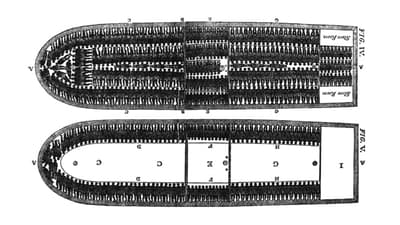
Between 1525 and 1866, slave ships embarked about 12.5 million Africans for the Americas, according to the Trans-Atlantic Slave Trade Database [1][3]. The database, edited by David Eltis and David Richardson, is hosted at Rice University and by 2008 had gathered records on nearly 35,000 voyages from 1501 to 1867 [1][3]. Its editors estimate that the records cover about 80 percent of the entire transatlantic African slave trade [3]. For each voyage, researchers sought dates, owners, vessels, captains, African visits, American destinations, numbers embarked, and numbers landed [3].
About 10.7 million Africans survived the Middle Passage and disembarked in North America, the Caribbean, or South America [1][3]. The database puts the mortality toll at more than 1.8 million African lives [3]. A separate overview gives a current estimate of about 12.75 million people loaded onto slave ships and up to 2 million deaths during the voyage [2]. The PBS account calls the database the best estimates available and the gold standard in the field [1].
Only about 388,000 of those 10.7 million were shipped directly to North America, the PBS account reports [1]. Henry Louis Gates Jr. describes that figure as a tiny percentage of the people who disembarked in the New World [1]. The same account places the rest of the disembarkations across the Caribbean and South America, not in a single destination [1].
Brazil absorbed the largest share of the trade. Out of roughly 12 million Africans forcibly brought to the western hemisphere, about 5.5 million went to Brazil between 1540 and the 1860s [4]. Until the early 1850s, most enslaved Africans arriving in Brazil embarked at West Central African ports, especially Luanda in present-day Angola [4]. Brazil was the last country in the Americas to abolish slavery, on 13 May 1888 [4].
Portugal led the major Atlantic slave trading nations in volume, followed by Britain, Spain, France, the Netherlands, the United States, and Denmark [2]. The largest slave trading ports were in South America, and ships based in the New World probably carried more enslaved people from Africa than ships with European home ports [2]. European traders generally purchased captives from West and Central African slave merchants rather than taking them by raid [2].
Enslaved Africans in the Americas worked on coffee, tobacco, cocoa, sugar, and cotton plantations, in rice fields, and in gold and silver mines [2]. They also worked in construction, timber cutting for ships, skilled trades, and domestic service [2]. The first enslaved Africans sent to the English colonies were classified as indentured servants, but by the middle of the 17th century colonial law had become a racial caste system of chattel slavery [2].
The database's 366-year span ends with 10.7 million landed and more than 1.8 million dead [1][3]. The 388,000 direct arrivals in North America represent about 3.6 percent of the 10.7 million who disembarked [1][3]. Brazil's 5.5 million arrivals alone exceed the North American total by more than five million people [4]. The database counts enslaved people, not cargo units or financial values [3].