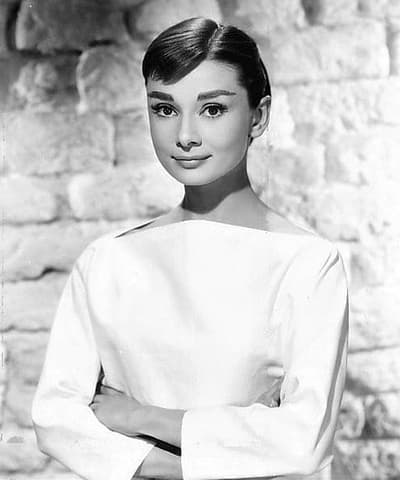
Imagine a stage. It isn't the bright, gilded expanse of a Hollywood soundstage, and there is no swelling orchestra to guide the rhythm. Instead, it is a dim, quiet room in the heart of an occupied territory. A young girl moves across the floor with a grace that seems almost otherworldly, but she does so in total silence. She isn't dancing for applause, and she isn't dancing for fame. She is dancing for survival.
This was the reality for a young Audrey Kathleen Ruston. To the world, she would eventually become Audrey Hepburn—the quintessential icon of elegance, a fashion legend, and one of the greatest screen stars to ever live. But before the Givenchy gowns and the Academy Awards, there was a girl whose life was being shaped by the brutal, quiet mathematics of war.
The Gift of Movement
From a young age, it was clear that Audrey possessed something rare. She didn't just move; she commanded space. Her talent was undeniable, a natural inclination toward the discipline and poise of classical ballet. This wasn't merely a childhood hobby; it was a calling she pursued with rigorous intensity.
By the mid-1940s, she was honing her craft under some of the most respected names in the industry. She studied in Amsterdam under Sonia Gaskell, absorbing the technical precision required of a professional dancer [1]. Later, as she moved toward London, she continued her training with the legendary Marie Rambert [1]. She had the lines, the discipline, and the burgeoning reputation of a true prodigy. In any other era, the trajectory was clear: the grand stages of Europe, the prestigious companies, the life of a prima ballerina.
But history had other plans.
Dancing in the Shadows
As the Second World War tightened its grip on Europe, the world of high art was replaced by the world of high stakes. During the occupation of the Netherlands, the simple act of existing became a political statement. For Audrey, her talent became a tool for something much more dangerous than art.
She began putting on silent dance performances—movements performed without the luxury of music—to raise money for the Dutch resistance. It was a breathtakingly brave endeavor. In an environment where every resource was controlled and every movement was watched, using the beauty of dance to fund a rebellion was an act of profound defiance. She was using her body not just to express emotion, but to fuel the machinery of liberation.
However, there was a hidden cost to this bravery. While she was helping to fight for the freedom of others, the war was quietly, systematically dismantling her own physical strength.
The Biological Toll of War
We often think of war in terms of battles fought on front lines, but for millions, the war was fought in the stomach. The occupation brought staggering levels of scarcity. Years of malnutrition, driven by the deprivation of the war years, began to leave their mark on Audrey’s developing body.
This is where the tragedy of her ballet career lies. Ballet is one of the most physically demanding disciplines in existence. It requires explosive power, immense bone density, and a caloric surplus to sustain the grueling, repetitive strain on the joints and muscles. Malnutrition does more than just cause weight loss; it fundamentally alters the structural integrity of a developing person. It weakens the very foundation upon which a dancer builds their career.
By the time the war ended, the damage was done. The girl who had once moved with the effortless strength of a prodigy found that her body could no longer meet the extreme physiological demands of professional ballet. The dream of the grand stage was effectively over, not because she lacked the talent, but because the war had stolen the physical capacity required to execute it.
The Pivot to the Screen
It is easy to look at this as a story of a lost dream, but it was actually the beginning of a different kind of legend. When the path of the ballerina closed, Audrey didn't stop performing; she simply changed the medium. She pivoted from the silent, physical language of dance to the expressive, emotive language of acting.
She began her journey in the West End, working as a chorus girl in musical theatre productions [1]. It was a humble start, a far cry from the heights of the ballet world, but it allowed her to refine her presence and her ability to connect with an audience. This transition eventually led her to Broadway and, ultimately, to the global stage of Hollywood.
The elegance we see in her films—the poise, the way she held herself, the unmistakable "line" of her silhouette—wasn't something she learned from a script. It was the residual grace of a dancer, a physical memory of the girl who had once danced in silence for a cause greater than herself. The malnutrition may have taken her ballet career, but it could never take the grace that defined her soul.