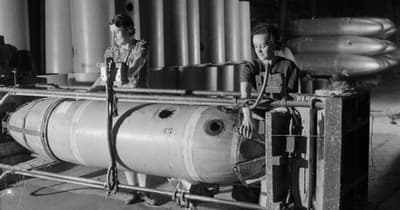
After training as an aircraft mechanic, Donald Marner found himself spending whole days hauling fuel tanks around a fighter base in England. He peeled off their heavy brown wrapping paper before delivering them to the parked Mustangs. The tanks underneath were made of paper too, ready to carry extra fuel on a flight over Europe and then be dropped.[1][2]
Marner recalled being told to keep at least a dozen at each aircraft parking position. When the stockpile ran low, he drove to an RAF base or depot and brought back more. He reckoned he had handled hundreds, perhaps thousands, of these tanks. For something intended to be thrown away, they occupied a considerable part of his working day.[1]
Why Britain Put Fighter Fuel in Paper
The demand had become urgent in 1943, when American bombers flying deep into Europe could travel beyond their fighter escorts' range. Carrying extra fuel in detachable tanks would let the fighters stay with them longer, without waiting for someone to design an entirely new airplane. The difficulty was getting enough tanks built and delivered.[3]
In May, the Americans asked Britain to manufacture steel tanks. Britain's Ministry of Aircraft Production proposed a paper version that could be produced more quickly and easily, and the Eighth Air Force successfully tested it before June ended. Approval didn't immediately fill the airfields with tanks, though. By October 12, the British had supplied only 450; by the end of 1943, that number had passed 7,500.[3]
Inside the factories, workers gave the paper its strength and shape in layers. Glue-soaked kraft paper went around wooden forms for the middle of each tank, while petal-shaped pieces built up the tapered ends. Workers smoothed out wrinkles and trapped air, added wooden baffles inside, and coated the interior with fuel-resistant lacquer. The three sections were pressed together, cured and pressure-tested before receiving their final coats of silvery paint.[2]
There was a limit to how long the finished tank could hold its contents. Fuel gradually attacked the glue, and leaks could develop within hours, so crews filled the tanks just before takeoff. A paper tank conserved scarce metal and only had to serve as a temporary container. Once its fuel had been used, the pilot could drop it.[2]
Getting Another Set Ready to Fly
By the time Marner was hauling replacements at Leiston in 1944, his P-51 Mustang group was escorting American heavy bombers over Europe. Each disposable tank had already required factory work, delivery and handling before he stripped off its wrapping. He remembered the paper tanks being lighter and easier to move than the metal ones.[1]
His mechanic's training still came into use after the hauling was done. When crews worked late in the hangars, he sometimes stayed to help until two or three in the morning. Before flights, they checked engines and looked for coolant, oil and gasoline leaks. Marner recalled helping stop leaks at the feed elbows connecting the paper tanks. With the checks finished, the heavily loaded Mustangs took off two abreast.[1]
Image: Ethel Prett (left) and Nellie Robery assemble jettison petrol tanks in Britain, 1944. Ministry of Information Photo Division / Imperial War Museums, D 23460. Public-domain archive photograph, cropped.
Sources
- Drop Tanks: The wartime Experience of Sgt. Donald W. Marner. Bud Anderson: To Fly and Fight, Donald Marner.
- Necessity Is The Mother of Invention: Paper Drop Tanks of WWII. Vintage Aviation News, Moreno Aguiari, August 18, 2013.
- Chapter 19: Build-up. HyperWar Foundation.