
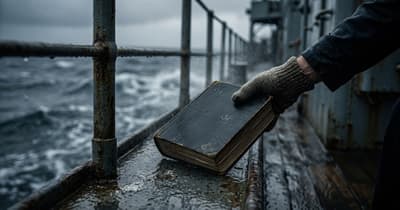
The sailor did not need to win a gun battle to protect a British signal book. He needed fire, if there was time. If there was no fire, he needed one clean throw over the rail.
Royal Navy signal codebooks could be bound with lead panels so that, if capture looked possible, sailors could throw the book overboard and trust it to sink before an enemy could read it.
On the first page of a surviving British S.P. 02201 General Signalling Instructions, the warning is built into the object. Crypto Museum notes that the book was individually numbered, marked confidential, signed with Admiralty instructions, and fitted with lead in the cover so it would go down when thrown into the sea.[1] It told operators how to build a naval message: origin time, addressee, recipient, priority, weather reports, status signals, and the small procedural habits that let ships understand each other at speed.[1]
On board, a threatened capture reduced all that paper to one drilled choice. Destroy the book at once. Fire was preferred, but a ship under pressure does not always provide a calm stove and spare minutes. The second method was the ocean. The lead panels turned an administrative object into emergency equipment, as if the Admiralty had admitted that secrecy sometimes depends on gravity.[1]
At Bletchley Park, another part of the same war was being fought with keys, pads, and printed sheets. The Government Code and Cypher School produced communications security materials for the Allies, including cipher keys, code books, and one time pads, with a small production unit in Oxford working near Oxford University Press for secret printing.[2] A codebook was paper, but it was also infrastructure. Someone had to compose it, number it, print it, guard it, correct it, and then be ready to destroy it.
In Bletchley offices, even unread messages could give themselves away. Traffic analysts studied the volume, direction, broadcast patterns, and call signs of enemy radio traffic to infer organization and location.[3] In that world, a captured procedure book was more than a list of phrases. It could teach an enemy how a navy arranged its attention.
A cover full of lead belongs to the sailor more than to the cryptographer. It assumes panic, wet hands, smoke, darkness, and a junior rating who may not know the larger intelligence picture but does know the motion. Burn it if you can. If not, throw it.
Most secret paperwork tries to look important by being stamped, signed, locked, or filed. This one carried its last instruction in its weight. Long before a reader reached the coded groups inside, the cover had already made a promise: if the ship was lost, the book would leave with it, dropping through green water as deliberately as a message sent in reverse.