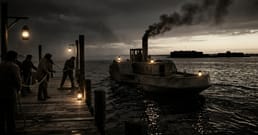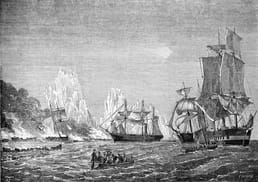
Before a fleet of old whaling ships left New Bedford in 1861, workmen bored holes through their hulls and fitted them with removable plugs. The crews would need those plugs to stay in place for the voyage south, then pull them out when they arrived. The U.S. Navy had bought the ships to sink them in the approaches to Charleston Harbor, where they were supposed to keep other vessels from getting through.[2]
Preparing the ships for this final assignment gave people ashore plenty to do. Whaling gear was sold off, and a contractor named James Duddy went into the countryside in search of stone to load aboard. According to John R. Spears's 1908 history, drawing on the New Bedford Mercury, farmers began dismantling walls and carting the stones away. The cargo needed to help the vessels stay down once their crews let the water in.[2]
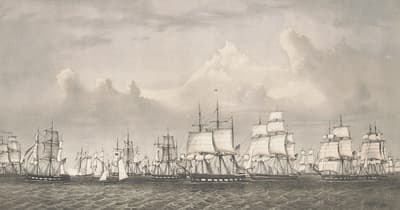
One of the ships, the Leonidas, had previously sailed from New Bedford on five whaling voyages and come home with sperm-whale oil. In November 1861 it set out carrying stone, joining old merchant vessels and other whalers in what became known as the Stone Fleet. The Navy was trying to tighten its Civil War blockade of a port whose many navigable channels gave blockade runners several ways to slip past the patrols.[1][3]
With supplies coming in and cotton going out, the Navy wanted obstructions that would make those passages harder to use. The ships sailed under sealed orders, though their purpose was sufficiently well known to provoke arguments in the newspapers. Supporters welcomed the scheme as a wartime measure, while opponents feared it would ruin the harbor permanently. There were also skeptics who doubted the wrecks would stop traffic for long.[1]
Captain Charles Henry Davis brought an uncomfortable qualification to his job overseeing the sinking: he was a hydrographer who had spent his career studying tides and making waterways more navigable. Writing to his wife, he called the assignment "a disagreeable duty, and one of the last I should have selected." Assistant Navy Secretary Gustavus V. Fox insisted on the plan, and Davis carried out the orders.[1]
On December 19 and 20, sailors sank the first sixteen vessels, removing the plugs and cutting down masts as they went. Even a ship destined for the bottom had things worth keeping, so the crews saved valuable sails and rigging before rowing away in small boats. A second group was sunk the following January to obstruct another entrance to Charleston Harbor.[1]
The wrecks disrupted traffic temporarily, but they could not hold the harbor closed. Some settled deep into the sand; others broke apart and floated away. Around the ships that remained, new channels formed, giving vessels routes through the water the Navy had tried to fill with stone.[1]
Sources
- Jamie L. Jones, The Navy's Stone Fleet, The New York Times (2012)
- John R. Spears, The Story of the New England Whalers (1908), pp. 389-393
- Stone Fleet, Wikipedia (background and vessel references)
Image: Stone Fleet depicted in a 1903 print reproducing an earlier lithograph. Library of Congress; public domain. Cropped.