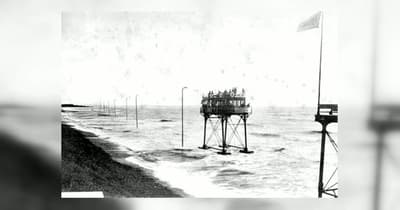
For five strange years, Brighton had a train that did not run beside the sea. It ran through it. Passengers climbed onto a wheeled platform on 23-foot legs, sat in a saloon above the waves, and rode across the foreshore as the English Channel moved underneath them.[1]
The Brighton and Rottingdean Seashore Electric Railway opened in November 1896 as Magnus Volk's solution to a very literal problem: the coast east of Brighton was awkward. Volk had already built Volk's Electric Railway, now remembered as the world's oldest operating electric railway, but extending it toward Rottingdean meant either climbing difficult cliffs or building along unstable undercliff ground.[2] So he chose the third option, rails in the surf.
The single car was officially named Pioneer, though almost everyone preferred its nickname: Daddy Long-Legs.[3] It looked less like a tram than a seaside pier that had learned to walk. The deck was about 45 feet long and 22 feet wide, supported by four tall tubular legs, each ending in a bogie running on rails fixed to the seabed.[2] Two General Electric motors drove it forward, while passengers rode in a central saloon and on an upper promenade deck.[2]
Because the vehicle moved through tidal water, it also had to obey maritime rules. A qualified sea captain was carried on board, along with lifeboats and safety gear, which made the whole invention feel like a railway pretending to be a ship.[1] Advertisements leaned into the absurdity and sold the ride as "A Sea Voyage on Wheels."[4]
The wonder nearly ended almost immediately. Less than a week after opening, a severe storm struck Brighton on the night of December 4, 1896. The old Chain Pier was destroyed, Volk's original railway was damaged, and Pioneer was knocked over badly enough that the project looked finished.[2] Volk rebuilt it anyway, raising the legs by two feet, and service resumed in July 1897.[1]
That comeback mattered because people loved the thing. In the remaining months of 1897, 44,282 passengers rode it through the shallows.[2] Its weakness was not public interest. It was physics, money, and the sea. At high tide, the underpowered car could slow to walking pace, and the company never had enough cash for stronger motors or a second vehicle.[2]
Then Brighton's coastal defenses changed the coastline around it. Groynes damaged the seabed near the track, and new sea defenses required the line to move into deeper water.[2] Volk could not afford the diversion. By 1901, the railway was dismantled for the barrier works, and a later plan for a more conventional viaduct never found the money.[1]
Daddy Long-Legs survives mostly in old photographs, a public-domain poster, and a few concrete sleepers visible at low tide.[3] That is the lovely, slightly ridiculous lesson of it: Victorian engineering did not only chase efficiency. Sometimes it built a tram with lifeboats, sent it into the Channel, and invited everyone aboard.