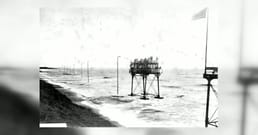
The people still aboard the wrecked hospital ship Rohilla had spent two nights waiting for help when a lifeboat stopped offshore and began pouring oil into the sea. It was November 1, 1914, and fifty people remained on the ship near Whitby. Rescuers had already hauled one boat over a sea wall and lowered another down the cliffs. The crew arriving from Tynemouth had a motor to help them reach the wreck, and a supply of oil to ease their passage through the breaking waves.[1]
Two days earlier, the Rohilla had struck rocks while sailing to Dunkirk to bring wounded men back to Britain. Its 229 people included medical staff and five nurses, who now needed rescuing themselves. Whitby coxswain Thomas Langlands could not approach through the heavy seas, so he had his No. 2 lifeboat dragged over an eight-foot wall and along the rocky shore. Damaged before it even launched, the boat nevertheless made two trips to the wreck, bringing back thirty-five people before the rocks battered it beyond further use.[1]
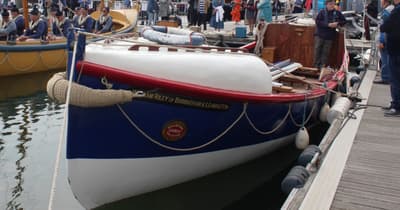
The next boat, the Upgang lifeboat William Riley, came through the town and across fields before being lowered down the cliffs on ropes. Its crew got within fifty yards of the wreck, only to be driven back; on shore, people waded into the surf to help those who jumped or were washed off. By Saturday afternoon, a call for help had reached Tynemouth. The motor lifeboat crew set out on a forty-four-mile journey through the storm and darkness, with the coast lights extinguished because of the war.[1][5]
When they reached Whitby, Lieutenant Basil Hall had oil transferred into their boat and joined them for the approach. The RNLI had been experimenting with oil at eight stations that year, looking for ways to reduce breaking seas. Sailors also had a simple means of dispensing it gradually: fish oil could seep through small holes pricked in a canvas bag, suspended from the line of a sea anchor.[1][2][4]
As the oil spreads into a thin film, it damps surface waves, which explains the vegetable and fish oils once carried as lifeboat equipment. Crews could not count on it to work in every sea. The RNLI's later assessment found its effect uncertain in heavy breakers, although it credited the oil with helping the Rohilla rescuers during their maneuver alongside the wreck.[2][3]
That Sunday morning, the crew released the oil where the current would carry it toward the stranded ship. A Yorkshire Post reporter, whose account the RNLI reproduced, described the water around the bridge becoming gently undulating. While it lasted, the lifeboat went around the stern and into the sheltered side of the wreck, close enough for the survivors to climb down. The waves were already growing higher again as men scrambled aboard, and two swept across the lifeboat before the crew finished. They took off all fifty people, with the ship's captain leaving last.[1]
At the quay in Whitby, townspeople were waiting with blankets and tea. Many of the survivors came ashore barefoot, some still in their pyjamas after two nights exposed to the sea. As they made their way up from the boat, the reporter noticed a sailor carrying a small black kitten on his shoulder.[1]
Sources
- RNLI: The Wreck of the S.S. Rohilla
- RNLI: The Use of Oil to Reduce Breaking Seas
- NOAA: In Some Situations, Ships Dump Oil on Purpose
- Royal Museums Greenwich: Oil Bag, EQA0088
- RNLI: Remembering Rohilla
Image: Restored William Riley in the foreground at the Poole Lifeboat Festival in 2024. This was the Upgang rowing lifeboat lowered down the cliffs during the rescue attempts, not the Tynemouth motor lifeboat that rescued the final fifty. Photo: Geof Sheppard / Wikimedia Commons, CC BY-SA 4.0. Cropped and resized; this derivative is shared under the same license.