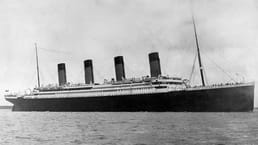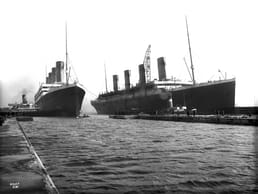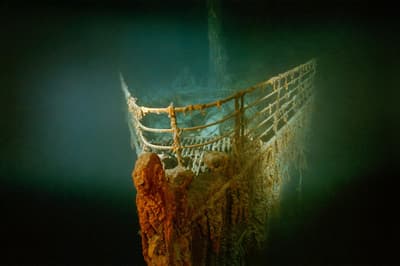
RMS Titanic sank in the early hours of 15 April 1912 after striking an iceberg on her maiden voyage from Southampton to New York, and roughly 1,500 of the 2,208 people aboard died [3][8]. The wreck lies about 12,500 feet down, some 325 nautical miles south-southeast of Newfoundland, in two main pieces about 2,000 feet apart [7]. A joint French-American expedition led by Jean-Louis Michel of IFREMER and Robert Ballard of the Woods Hole Oceanographic Institution found it in 1985 from the research vessel Knorr, using side scan sonar [6][7]. The expedition succeeded in part because of support Ballard secured after locating two sunken nuclear submarines at the U.S. Navy's request [7].
USS Thresher sank on 10 April 1963 during deep-diving tests about 350 kilometers east of Cape Cod, killing all 129 crew and shipyard personnel aboard [4]. USS Scorpion imploded and sank on 22 May 1968, and it is one of the two nuclear submarines the Navy has lost, the other being Thresher [5]. Both boats came to rest in the North Atlantic with their reactors and armaments still aboard [5]. Their locations had never really been mapped, Ballard said [11].
Ballard, a retired Navy commander and professor of oceanography at the University of Rhode Island, was building a deep-sea robot called Argo [2][6]. He approached the Navy about using it to search for Titanic [6]. Deputy Chief of Naval Operations Ronald Thunman agreed to finance the Knorr's Titanic work on one condition: Ballard would first search for and investigate the two submarines, determining the state of their reactors after decades underwater and whether radioactivity was affecting the environment [6][10].
The Navy had no intention of announcing the submarine survey. "They did not want the world to know that, so I had to have a cover story," Ballard told CNN [10]. The service worried that Soviet ships would follow his vessel to the Scorpion, where it wanted to inspect nuclear weapons and reactor effects without an audience [10]. The voyage was billed purely as a hunt for Titanic, and the press was kept in the dark [10]. Ballard said the Navy did not want the Soviets to know it was looking for the submarines [11].
What the team found on the seabed changed how it searched. Both submarines had imploded under the immense pressure at depth, scattering thousands of pieces of debris across the ocean floor [6]. Following that trail of wreckage led them directly to each hull, a far easier method than hunting for the hulls themselves [6]. The debris fields spread out for about a mile [11]. The reactors had shut down, with control rods down, which Ballard called a good ending [11].
After the submarine work, the team had 12 days left on the Navy contract to find Titanic [10][11]. Argo swept back and forth across the bottom, following a debris trail rather than looking for the ship itself [6]. The approach worked. The discovery drew global attention, and the New York Times report on it included Navy officials denying the mission's true purpose [10].
Ballard's career did not begin or end with the liner. He found hydrothermal vents, undersea volcanic features whose ecosystems run without sunlight, and said that finding them "beats the hell out of finding the Titanic" [2]. He later located the battleship Bismarck in 1989, the aircraft carrier USS Yorktown in 1998, and John F. Kennedy's PT-109 in 2002 [2]. Titanic itself sits too fragile to raise after more than a century on the bottom and is protected by a UNESCO convention [7]. In June 2023 the submersible Titan imploded near the wreck, killing all five people aboard [7].
Ballard stayed silent about the Navy's role for about two decades, under instructions not to discuss it [11]. The fuller account reached the public through the National Geographic documentary "Titanic: The Final Secret" and reporting by outlets including National Geographic News and CNN [1][9][11].