The Titanic sank in the early hours of April 15, 1912. Twenty-nine days later, audiences could buy a ticket and watch it happen again.
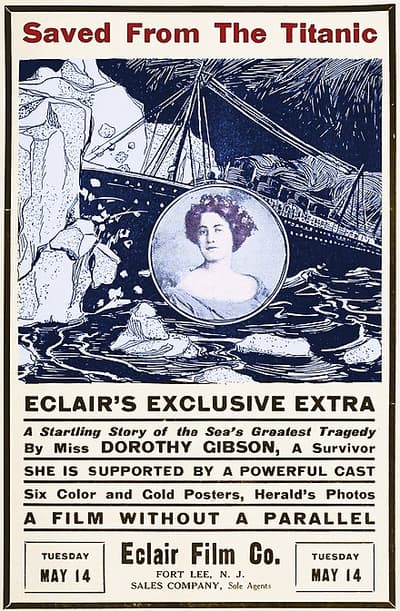
That speed is the first startling thing about Saved from the Titanic. The second is stranger. Its star was Dorothy Gibson, an actual Titanic survivor. And when she stepped in front of the camera to reenact the disaster, she reportedly wore the same clothes she had worn on the night the ship went down.[1]
It is hard to imagine a cleaner collision between trauma and entertainment. Modern culture likes to think turning catastrophe into media is a recent vice, something born with cable news, social media, and the algorithmic appetite for fresh horror. But here it was in 1912, almost immediately: mass death, public fascination, dramatization, branding, release.
Only this version had a woman at its center who had actually been there.
The Survivor Who Became The Story
Dorothy Gibson was not some anonymous extra chosen because she vaguely resembled a witness. She was already a film actress, and she had survived the Titanic by boarding Lifeboat No. 7, the first lifeboat launched from the ship.[1] That detail alone would have made her marketable. But Saved from the Titanic went further than simple casting. Gibson helped write the script and played a fictionalized version of herself, recounting the disaster after her rescue.[1]
That matters because it makes the film something more complicated than a cheap dramatization. It was also, in a sense, an early claim to authority. The public did not just want a Titanic story. It wanted proximity to the real thing. Gibson could offer that in a way no set, no prop, and no invented heroine could.
And she could offer something even more powerful than eyewitness testimony. She could offer embodiment. She was not merely telling audiences what happened. She was carrying the event back into view with the same face that had seen it.
The Dress Made It Real
Then there were the clothes.
According to contemporary accounts, Gibson wore in the film the same clothing she had worn aboard the Titanic that night.[1] That is the detail that pushes the whole episode from merely fascinating into something faintly surreal. Clothes are intimate evidence. They hold shape. They suggest continuity. They imply that the gap between the event and its reenactment was not really a gap at all.
It is one thing to rebuild a tragedy in a studio. It is another to place one of its survivors before a camera still wrapped, in effect, in the costume of survival itself.
That choice was clearly meant to heighten authenticity. And it did. But it also exposed something deeper about the emotional logic of early disaster culture. Audiences did not simply want representation. They wanted contact, however indirect. The dress was not just wardrobe. It was proof.
A Movie Made At The Speed Of Shock
Saved from the Titanic premiered in the United States less than a month after the sinking, making it the earliest known dramatization of the disaster.[1] That turnaround is astonishing even now. In practical terms, it meant writing, shooting, promoting, and releasing a film while grief was still raw and headlines still fresh.
This was the silent era, but silence did not mean restraint. Early cinema moved fast, and topicality was part of its power. If newspapers could convert catastrophe into print by morning, film was already learning to convert it into spectacle by the next available reel.
The plot was built around Gibson recounting the sinking to her fictional parents and fiancé, with the film intercutting that retelling with stock footage, including icebergs and images used to stand in for the Titanic.[1] By later standards, that sounds rudimentary. By the standards of 1912, it was almost unnervingly immediate, a dramatized news echo while the event still felt unfinished in public memory.
The First Titanic Film Was Also A Lost Film
And then comes the final twist. The film itself is gone.
Saved from the Titanic is now considered a lost film.[1] A work created to seize one of the most talked-about disasters in modern history, made with a real survivor at its center and marketed through its closeness to the event, has itself vanished. What remains are reviews, production details, stills, and the strange afterimage of the premise.
That disappearance gives the story an eerie symmetry. The Titanic became a legend partly because so much of it slipped beneath the surface all at once. And the first film made about it, rushed into existence while the shock was still fresh, also receded into absence.
We are left with a ghost of a ghost: a lost movie about a sunken ship, starring a woman who escaped both.
Why The Story Still Feels Modern
What makes Saved from the Titanic feel surprisingly contemporary is not just the speed or the opportunism. It is the instinct behind it. The instinct to collapse the distance between event and representation. To ask the survivor not merely to speak, but to perform. To take catastrophe and make it legible, saleable, and emotionally immediate before the public has had time to look away.
That instinct is now so familiar it barely feels like an instinct at all. It feels like infrastructure. But in 1912, it was still raw enough to seem astonishing.
And Dorothy Gibson remains the most arresting part of it. She survived the most famous shipwreck of her age, returned to New York, helped write a film about it, and stood before a camera in the same clothes she had worn while escaping the real thing.[1] There is bravery in that, perhaps. Or professionalism. Or pressure. Probably all three.
But above all there is a disturbing clarity. The twentieth century had barely begun, and modern media had already found one of its defining habits: tragedy first, reenactment almost immediately after.