A British reviewer wanted to know how a drowned sailor had sent his notes to the publisher. It was a reasonable question to ask of the book in front of him. Herman Melville had introduced a narrator named Ishmael, taken him on a whaling voyage, and apparently sunk him along with everyone else. The Literary Gazette asked how Ishmael, who appeared to have drowned, had communicated his notes to Mr. Bentley.[1]
The first British edition of Moby-Dick, published as The Whale in 1851, omitted the epilogue explaining Ishmael's survival. Some reviewers consequently complained that its narrator seemed to have drowned before he could tell his story.
Richard Bentley issued the novel in London on October 18, in three volumes with sea-blue covers and cream spines decorated with gold whales. There were 500 sets. A reader could hold a handsome, finished object, complete with all that expensive binding, and still be missing the answer to the book's most elementary question: who lived to tell it?[2]
Melville had already tried to protect his words on their way into print. While still writing the later portions, he arranged to have the novel set in type and copy-edited. The British edition would nevertheless be reset. By the time Bentley's version appeared, material had been cut and rearranged. Nobody knows for certain why the epilogue disappeared. It may have been lost when other sections were moved. The missing rescue should not be confused with the deliberate cuts elsewhere in the British text.[2][3]
The London Spectator supplied a brisk rule for the damaged book: a novelist should not report things his narrator could never have known. It offered the example of conversations among miners if every miner died. A reader who had followed Ishmael aboard the Pequod could fairly ask where he had gone when the vessel sank. The review turned a missing passage into an objection to Melville's storytelling.[1]
Across the Atlantic, Harper & Brothers published the American edition on November 14, with the rescue intact. British criticism traveled there too. The Boston Post announced that it had read nearly half the book and already agreed with the Athenaeum's unfavorable verdict. A New York magazine reprinted the Spectator's attack. The Spectator's objection now sat before American readers whose copies contained the very passage that answered it. Comparing the editions would have cleared up this particular complaint. Reprinting the review carried it farther.[2]
In the American epilogue, Ishmael is floating near the wreck when a coffin, converted into a life buoy, shoots up from the sea. It had been made for his shipmate Queequeg. Ishmael holds on for almost a whole day and night. On the second day, the Rachel picks him up while searching for its own missing children.[4]
At the end of that short rescue, the Rachel finds what Melville calls "another orphan." Ishmael can tell the story because he has lost the people who might have told it with him.[4] The British reviewer looking for the source of those notes had good reason to ask. His three handsome volumes had left the narrator in the sea, without the coffin to hold on to.
Sources
- Moby-Dick: publication and reception history
- Library of America: the London publication and reviews
- Smithsonian: the first editions of Moby-Dick
- Herman Melville, Moby Dick; or, The Whale, epilogue
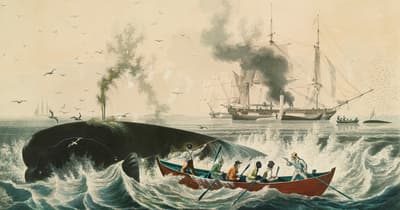
Image: South Sea Whale Fishery (1835), engraved by E. Duncan after Garnerey. Mitchell Library, State Library of New South Wales, via Wikimedia Commons. Public domain; cropped. Historical whaling scene, not a depiction of Ishmael.